
When smart home gadgets are discussed, most articles talk about features, apps, and automation.
However, for Indian households, the real concern is much simpler:
“Will this actually reduce my electricity bill or save money?”
Because of this, many people hesitate before buying smart gadgets, especially on a limited budget.
This article answers that question with real-life Indian home examples, actual power usage patterns, and practical savings calculations.
No exaggeration. No luxury-home assumptions. But, just realistic scenarios that apply to most Indian families.
If you are new to smart gadgets, you should first read our main guide on top smart home gadget essentials for budget Indian homes (2026) to understand what to buy.
This article focuses on how those gadgets actually save money in daily life.
👉 https://smartdealfinds.com/top-smart-home-gadget-essentials-for-budget-indian-homes-2026/
Why Electricity Wastage Happens in Indian Homes (Even When We’re Careful)
According to multiple energy efficiency studies, a noticeable portion of household electricity usage in India comes from standby power and appliances running longer than necessary.
However, this wastage does not usually happen due to carelessness.
In most cases, it happens because of busy routines, mental overload, and simple forgetfulness.
For example, geysers are often left ON longer than needed, lights stay ON in unused rooms, and routers run 24/7 without reason.
Because of this, electricity consumption increases silently, even in homes where people try to be careful.
This is exactly where smart gadgets help—not by changing human behavior, but by removing forgetfulness from the system.
However, this wastage usually does not happen due to negligence.. In most Indian households, electricity is wasted because of:
- Busy daily routines
- Forgetting to switch off appliances
- Geysers and ACs running longer than needed
- Lights staying ON in unused rooms
- Standby power from TVs and routers
That’s where smart gadgets help. They don’t try to change human behavior. They don’t try to change human behavior.
Real-Life Example 1: Smart Plug + Geyser (Biggest Monthly Saving)
Common Indian Situation
In most homes:
- Geyser is switched ON before bathing
- Often forgotten and left ON for 1–2 extra hours
Actual Power Usage
A typical geyser consumes 2–3 units per hour.
If left ON unnecessarily for 2 hours daily:
- 2 units × 30 days = 60 units/month
- Average cost: ₹7/unit
- ₹420 wasted every month
What Changes with a Smart Plug
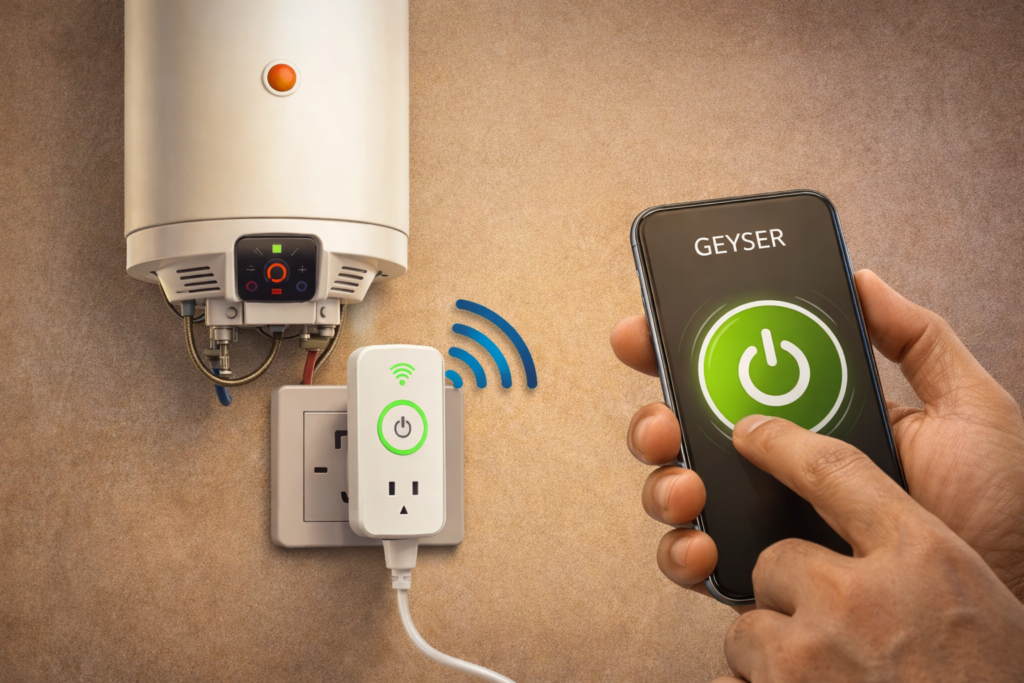
- Geyser auto-OFF after a fixed time
- Or switched OFF remotely if forgotten
Realistic Saving
Even saving 30 units/month:
- ₹200–₹250 saved monthly
- ₹2,400–₹3,000 saved yearly
👉 Check reliable smart plugs suitable for geysers on Amazon
Real-Life Example 2: Motion Sensor Night Lights (Silent but Consistent Saving)

Typical Habit
- Bathroom or hallway light ON all night
- Common in homes with elderly parents or children
Power Reality
A 9W LED bulb running 8 hours nightly:
- ~2 units/month
With Motion Sensor Lights
- Light turns ON only when movement is detected
- Usage drops from hours to minutes
Result
- Lower power usage
- Improved night-time safety
- No manual switching required
👉 View motion sensor night lights for Indian homes on Amazon
Real-Life Example 3: Smart LED Bulbs in Daily Use
Before Smart Lighting
- Lights ON from evening till bedtime
- Often forgotten in unused rooms
After Smart Lighting
- Scheduled auto-OFF
- Dimming used instead of full brightness
Monthly Impact
Reducing usage by just 1 hour per day per bulb:
- ~1 unit saved per bulb per month
- 5 bulbs = 5 units/month
👉 Explore energy-efficient smart LED bulbs on Amazon
Real-Life Example 4: Router & TV Standby Power Control
Common Scenario
- Router ON 24/7
- TV in standby mode all night
Standby Power Adds Up
Small consumption × long duration = real cost over time.
Smart Plug Solution
- Router scheduled OFF at night
- TV completely powered down
👉 Check smart plugs for routers and TVs on Amazon
Real-Life Example 5: AC Usage Control with Smart IR Remote
Typical AC Problem
- AC runs longer than needed
- People fall asleep and forget timers
Smart Control Benefit
- AC auto-OFF after fixed duration
- Remote control even when forgotten
Even reducing AC usage by 30 minutes per night:
- Significant monthly savings
- Lower electricity bill spikes
👉 See smart IR remotes for AC and TV control on Amazon
Calculation-Based Table: Monthly Electricity Savings (Indian Home)
| Smart Gadget | Units Saved / Month | Approx Monthly Saving |
|---|---|---|
| Smart Plug (Geyser) | 30–60 units | ₹200–₹400 |
| Motion Sensor Lights | 3–5 units | ₹20–₹40 |
| Smart LED Bulbs | 6–10 units | ₹50–₹80 |
| Router/TV Scheduling | 4–6 units | ₹30–₹50 |
| AC Smart Control | 10–15 units | ₹150–₹250 |
👉 Total realistic saving: ₹450–₹800 per month
👉 Yearly saving: ₹5,000–₹9,000
Real Case Example: 2BHK Indian Household (Before vs After)
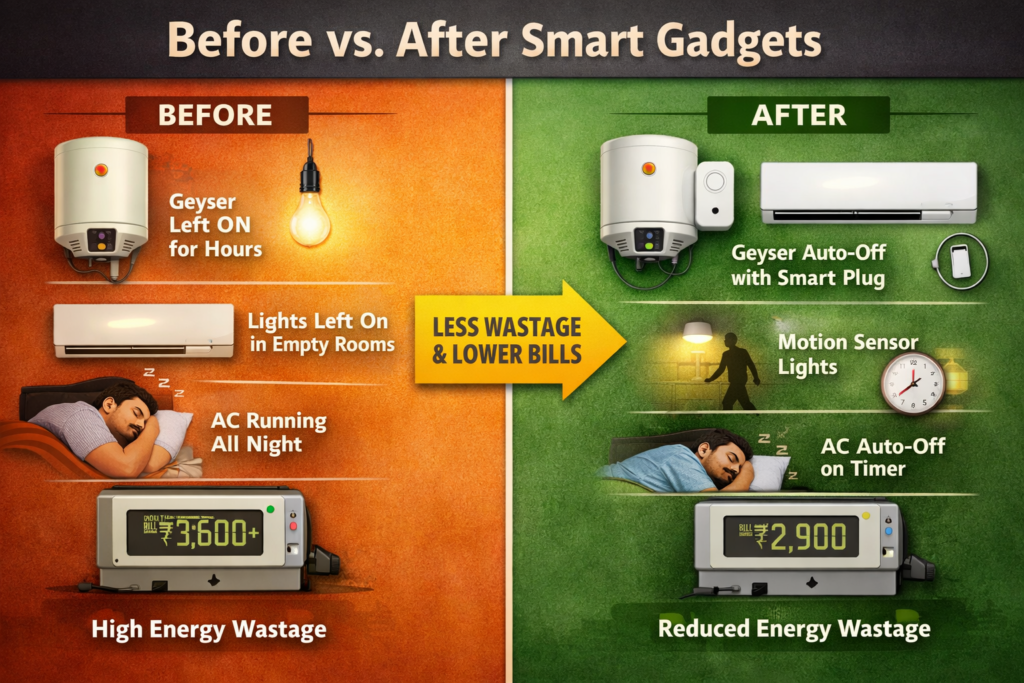
A middle-class family living in a 2BHK apartment typically paid around ₹3,600 per month in electricity bills during peak usage months.
After adding:
- One smart plug for the geyser
- Motion sensor lights for night use
- Scheduled smart bulbs in bedrooms
Their average bill reduced to around ₹2,900–₹3,000 within three months, without changing daily comfort.
The biggest difference was not reduced usage—but reduced wastage.
Cost Recovery (ROI) Table – Why Smart Gadgets Make Sense
| Gadget | Approx Cost | Monthly Saving | Cost Recovery Time |
|---|---|---|---|
| Smart Plug | ₹800 | ₹250 | ~3 months |
| Smart LED Bulb | ₹600 | ₹50 | ~4 months |
| Motion Sensor Light | ₹700 | ₹30 | ~5–6 months |
| Smart IR Remote | ₹1,500 | ₹200 | ~7–8 months |
This is why smart gadgets are not expenses, but slow-return investments.
Real Household Case Study: Middle-Class 2BHK Family
Before Smart Gadgets
- Geyser often left ON
- Lights ON in unused rooms
- AC usage uncontrolled
- Higher and unpredictable bills
After Basic Smart Setup
- Smart plug for geyser
- Motion lights at night
- Smart bulb scheduling
- AC usage controlled
Outcome After 3 Months
- Noticeably lower electricity bill
- Less stress about switches
- No lifestyle compromise
Why Smart Gadgets Work Better Than “Being Careful”
Many people say:
“We’ll just remember to switch things off.”
Reality:
- Humans forget
- Habits slip
- Busy days override intentions
Smart gadgets don’t rely on memory.
They enforce discipline automatically, every single day.
Who Benefits Most from Power-Saving Smart Gadgets?
✔ Homes with geysers
✔ Families with kids or elders
✔ Work-from-home professionals
✔ Homes with AC usage
✔ Anyone tired of high electricity bills
For budget options, also check our curated list of useful Amazon finds under ₹999 for Indian homes.
👉 https://smartdealfinds.com/7-useful-amazon-finds-for-indian-homes-under-%e2%82%b9999-2026/
Simple Actions You Can Take This Week to Reduce Electricity Bills
- Install a smart plug on your geyser and set an auto-off schedule
- Replace at least one night bulb with a motion sensor light
- Schedule bedroom lights to turn off automatically at night
These three small steps alone can reduce unnecessary electricity usage without affecting comfort.
Final Honest Advice for Indian Homes (2026)
Smart home gadgets will not magically cut your bill in half.
But they consistently reduce wastage, month after month.
If your goal is:
- Reducing unnecessary power usage
- Saving money gradually
- Improving comfort and safety
Smart gadgets are absolutely worth it.
Instead of searching product by product, explore a curated list of power-saving smart gadgets designed for Indian homes.
👉 Explore Smart Power-Saving Gadgets on Amazon
Affiliate Disclosure
As an Amazon Associate, I earn from qualifying purchases.
This does not affect the price you pay and helps support SmartDeal Finds in creating practical, unbiased content.
Writer’s View: Honest Perspective After Studying Real Indian Usage
After reviewing hundreds of Indian user experiences and real usage patterns, one thing becomes very clear:
Smart home gadgets don’t save money because they are “smart.”
They save money because they remove human inconsistency.
In most Indian homes, electricity wastage happens unintentionally:
- We rush to work and forget switches
- We leave geysers ON “just for a while”
- We fall asleep with the AC running longer than needed
No amount of intention fixes this consistently. Automation does.
What surprised me most while researching Indian user reviews and usage patterns is that the biggest savings come from very small habits, not expensive devices.
A single smart plug on a geyser often saves more money than multiple fancy gadgets combined.
Another important observation is this:
The most satisfied users are not tech lovers — they are people who just wanted fewer things to worry about.
Families with elderly parents, working couples, and renters benefit the most because smart gadgets work quietly in the background. Once set up, they don’t demand daily interaction or learning.
My honest advice to Indian readers is simple:
- Don’t try to make your home futuristic
- Don’t buy everything at once
- Start with one real problem (like high bills or night safety)
If a gadget solves that problem reliably, As a result, it’s worth keeping.
If it doesn’t, skip it.
That mindset—not technology—is what actually makes a smart home successful in India.
Frequently Asked Questions (Real Questions from Indian Buyers)
❓ Do smart home gadgets really reduce electricity bills in India?
Yes, but gradually. They reduce wastage, not essential usage. Over time, this leads to noticeable savings.
❓ How much can a normal Indian family realistically save?
A typical middle-class household can save ₹300–₹800 per month, depending on usage patterns and appliances like geysers and ACs.
❓ Are smart gadgets difficult to use for parents or elderly people?
No. Most gadgets work automatically once set up. Parents usually don’t need to use the app daily.
❓ What happens if there is a power cut?
Most smart gadgets pause during power cuts and resume automatically once power returns. Settings are usually saved.
❓ Do smart gadgets increase electricity consumption because they are always connected?
The power consumption of smart gadgets themselves is very low. The savings from reduced wastage are far higher than their own usage.
❓ Is stable internet mandatory for all smart gadgets?
Basic Wi-Fi is sufficient. Most gadgets work on 2.4 GHz networks and don’t require high-speed internet.
❓ Are smart gadgets safe to use with Indian voltage conditions?
Yes, when you choose trusted brands. Using surge protectors is recommended for added safety.
❓ Which smart gadget should I buy first if my budget is limited?
Start with a smart plug or motion sensor night light. These offer the quickest real-life benefits.
❓ Are smart gadgets suitable for rented houses?
Absolutely. Most are plug-and-play and can be removed easily when shifting homes.
❓ How long do smart gadgets usually last?
With normal usage and trusted brands, most gadgets last 3–5 years or more.
❓ Can smart gadgets work without Alexa or Google Assistant?
Yes. Voice assistants are optional. All essential functions work through mobile apps.