
If you are opening your utility statements each month with a sense of dread, you are not alone. Between mounting inflation and unpredictable global energy markets, rising electricity prices in the USA and Europe are putting massive pressure on household budgets. Whether you are dealing with the shock of high winter heating costs or skyrocketing summer AC bills, figuring out how to reduce your electric bill has become a top priority for homeowners and renters alike.
The good news? You don’t need to install a massive solar panel array or undertake a full, expensive home renovation to see real relief. Small, strategic, and smart changes in your daily routine and home setup can lower electricity costs by 10% to 40%.
This guide focuses purely on realistic, practical strategies. Whether you live in a spacious suburban home or a compact city apartment, these proven methods will help you regain control over your energy consumption.
Disclaimer:
As an Amazon Associate, I earn from qualifying purchases. This means if you click on an affiliate link and make a purchase, Smart Deal Finds may earn a small commission at no extra cost to you. We only recommend products we genuinely believe will help you save money.
Quick Recommendations:
Best for US Heating & Cooling: Google Nest Thermostat – The absolute easiest way to automate your home and cut HVAC costs by 10–15%.
Best for Total Home Tracking: Emporia Smart Home Energy Monitor – Find out exactly which appliances are draining your wallet in real time.
Best Quick Fix : Kasa Smart Power Strip – Kills “vampire power” instantly to stop your electronics from wasting electricity while turned off.
1. Understand Where Your Money Goes
Before you can effectively cut costs, you need to know exactly what is draining your power. Energy consumption varies widely depending on your home’s size, age, and location, but the main culprits remain relatively consistent.
The Major Energy Drains
- Heating & Cooling (Space Conditioning): By far the largest share of household energy use, often accounting for 40% to 50% of your total bill.
- Water Heating: Taking up roughly 15% to 20% of your energy budget, hot water is a silent drain, especially if your tank is poorly insulated.
- Kitchen & Laundry Appliances: Refrigerators, ovens, washers, and dryers are heavy, consistent draw appliances.
- Lighting: While less of an issue with modern bulbs, leaving older incandescent lights on still wastes significant power.
- Standby Power (“Phantom Energy”): Electronics plugged in but not in use (TVs, gaming consoles, chargers) can quietly add 5% to 10% to your monthly costs.
USA vs. Europe: Regional Differences
- Heating Systems: In the USA, forced-air HVAC systems (often electric or natural gas) are the standard. In Europe, especially in countries like Germany and the UK, hydronic (water-based) heating with radiators or underfloor heating is much more common.
- Housing Types: American homes are generally larger and standalone, meaning more square footage to heat and cool. European homes and apartments are often more compact but may reside in older, historically protected buildings where adding heavy insulation is restricted.
- Energy Pricing Models: The US is increasingly adopting Time-of-Use (TOU) pricing, but flat rates are still common. In Europe, highly dynamic pricing, smart meter integration, and strict off-peak tariffs are standard, making the timing of your energy use just as important as the volume.
2. 12 Practical Ways to Reduce Energy Consumption at Home
1. Adjust Your Thermostat Strategically
- Why it works: Every degree you lower your thermostat in winter (or raise it in summer) reduces the load on your HVAC or boiler.
- Estimated savings range: 1% to 3% per degree adjusted.
- Who benefits most: Everyone, especially those in poorly insulated homes.
- Implementation: Set your thermostat to 68°F (20°C) while awake in winter, and lower it while sleeping or away. In summer, aim for 78°F (25°C).
2. How to Reduce Your Electric Bill with Smart Thermostats
- Why it works: These devices learn your schedule and automatically adjust temperatures, ensuring you never pay to heat or cool an empty house.
- Estimated savings range: 10% to 15% on heating and cooling.
- Who benefits most: People with regular working hours outside the home and houses with central HVAC systems.
- Implementation: Replace your standard wall unit. Most modern smart thermostats take under 30 minutes to wire.
3. Target European Radiators with Smart Valves
- Why it works: Standard in Germany and across Europe, hydronic radiators often heat unused rooms. Smart radiator valves allow room-by-room zoning.
- Estimated savings range: Up to 30% on heating costs.
- Who benefits most: European apartment dwellers and homeowners with wall radiators.
- Implementation: Unscrew your old manual thermostatic valve and click the smart valve into place.
4. Switch Entirely to LED Lighting
- Why it works: LEDs use up to 90% less energy than incandescent bulbs and last 25 times longer.
- Estimated savings range: $50–$100 annually for a whole-house swap.
- Who benefits most: Renters and homeowners with older fixtures.
- Implementation: Replace your most frequently used bulbs first (living room, kitchen).
5. Kill Phantom Power with Smart Power Strips
- Why it works: Devices draw power even when turned off. Smart strips cut power to peripheral devices when the main device (like a TV or PC) is turned off.
- Estimated savings range: 5% to 10% of total electricity bill.
- Who benefits most: Homes with multiple entertainment centers or home offices.
- Implementation: Plug your TV into the “control” outlet and soundbars/consoles into the peripheral outlets.
6. Run Appliances During Off-Peak Hours
- Why it works: If you are on a TOU plan or European smart meter tariff, electricity is cheaper at night or midday (when renewable generation is high).
- Estimated savings range: 10% to 20% on appliance running costs.
- Who benefits most: Users with smart meters or TOU utility plans.
- Implementation: Use the delay-start feature on your dishwasher and washing machine to run at 2 AM.
7. Improve Rent-Friendly Insulation
- Why it works: Sealing air leaks prevents conditioned air from escaping, reducing the workload on your heating/cooling system.
- Estimated savings range: 5% to 10% on conditioning costs.
- Who benefits most: Renters and owners in older buildings.
- Implementation: Apply weatherstripping tape to window frames and use draft stoppers under exterior doors.
8. Lower Your Water Heater Temperature
- Why it works: Most water heaters are set to 140°F (60°C) by default, which is hotter than necessary and wastes standby energy.
- Estimated savings range: 4% to 22% annually on water heating.
- Who benefits most: Homes with traditional tank-style water heaters.
- Implementation: Turn the dial down to 120°F (49°C).
9. Wash Laundry in Cold Water
- Why it works: Heating water accounts for about 90% of the energy your washing machine uses. Modern detergents are formulated to work perfectly in cold water.
- Estimated savings range: $40–$60 per year.
- Who benefits most: Families who do multiple loads of laundry per week.
- Implementation: Simply turn the dial on your washer to the “cold” or “eco” setting.
10. Maintain HVAC Filters and Radiators
- Why it works: A clogged AC filter or a radiator full of trapped air forces your system to work harder and run longer to achieve the same temperature.
- Estimated savings range: 5% to 15% on cooling/heating efficiency.
- Who benefits most: Anyone with central air or hot water radiators.
- Implementation: Change AC filters every 30–90 days. “Bleed” European radiators with a radiator key at the start of every winter.
11. Invest in Energy-Efficient Appliances
- Why it works: Appliances with an ENERGY STAR (USA) or high EU Energy Label rating use advanced compressors and better insulation.
- Estimated savings range: Varies heavily; replacing an old fridge can save $50+ annually.
- Who benefits most: Homeowners ready for an appliance upgrade.
- Implementation: Look for the yellow or colorful tiered rating stickers when shopping.
12. Utilize Natural Lighting and Ventilation
- Why it works: Using the sun for heat and light, and cool night air for AC, costs absolutely nothing.
- Estimated savings range: Highly variable, but completely free.
- Who benefits most: Homes with south-facing windows or good cross-ventilation.
- Implementation: Open curtains on sunny winter days to warm rooms. In summer, close blinds during the day to block solar heat gain.
3. Best Energy Saving Devices for 2026
If you want to automate your savings, these are some of the most reliable, high-return investments you can make for your home.
1. Google Nest Thermostat
An accessible, stylish smart thermostat that pays for itself.
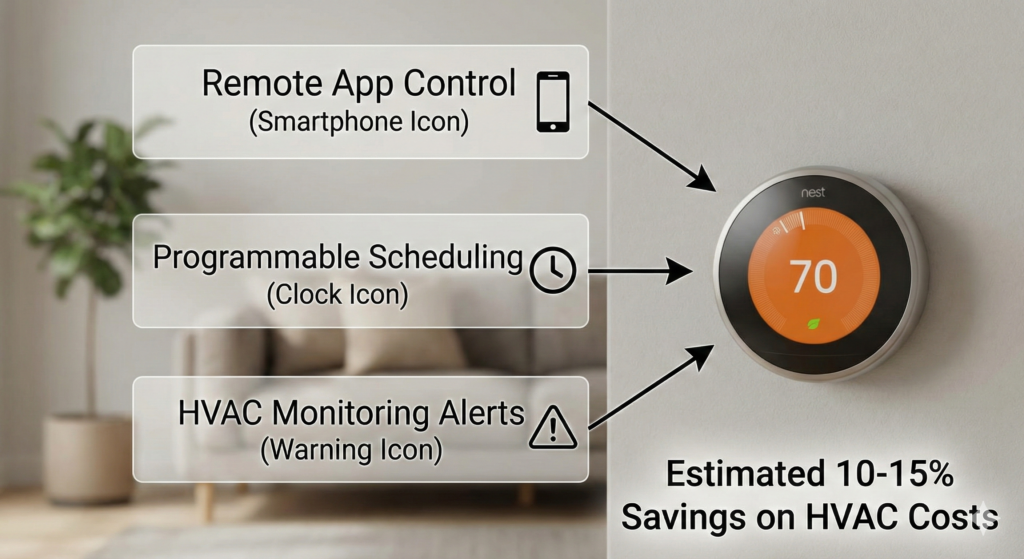
Why it saves electricity: It monitors your habits and uses “Eco Mode” to automatically lower energy usage when you leave the house.
Ideal user: Homeowners and renters with standard central heating/cooling systems looking for a budget-friendly smart upgrade.
Key features: Programmable scheduling, remote app control, HVAC monitoring alerts.
Pros: Sleek minimalist design, very easy app interface, excellent price point.
Cons: Lacks the learning features of the premium “Learning” model.
Real-life use case: Your AC automatically adjusts when your phone’s location shows you’ve left for work, preventing you from cooling an empty house all day.
Estimated energy savings: 10–12% on heating, 15% on cooling.
Price category: Budget / Mid
2. Emerson Sensi Touch Smart Thermostat
A premium, large-display thermostat with deep smart home integration.
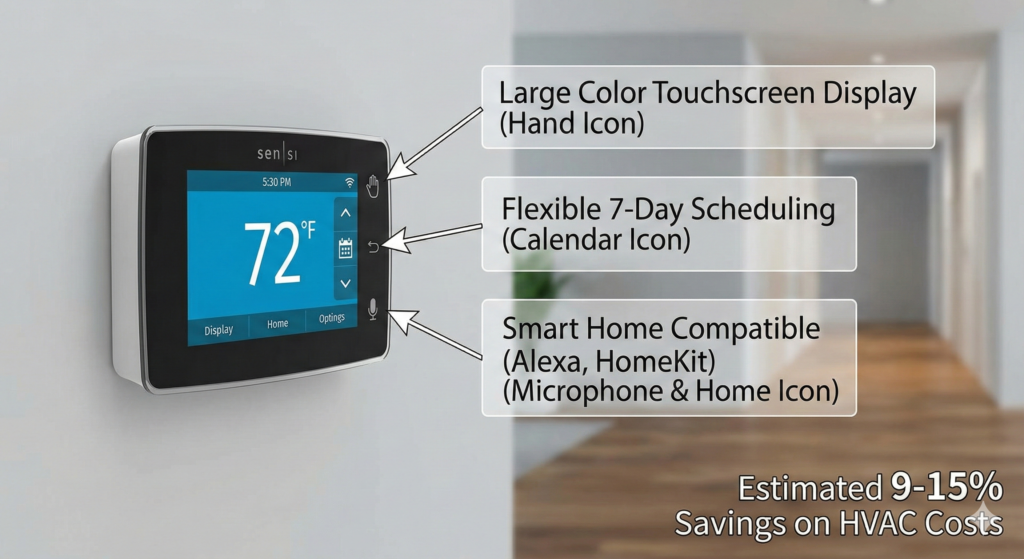
Why it saves electricity: Provides flexible 7-day scheduling and geofencing to ensure exact temperature control without wasted run-times.
Ideal user: Homeowners who prefer a traditional, easy-to-read touchscreen display over a dial-based interface.
Key features: Apple HomeKit & Alexa compatible, high-contrast color touchscreen, energy usage reports.
Pros: Highly intuitive interface, excellent smart home compatibility, great for older eyes.
Cons: Requires a C-wire (common wire) for installation.
Real-life use case: Checking your monthly usage reports directly on the large screen to see exactly how your weekend schedule adjustments lowered your bill.
Estimated energy savings: About 9% on heating and 15% on cooling.
Price category: Premium
3. Kasa Smart Plug Power Strip by TP-Link
Stop vampire devices from quietly draining your wallet.
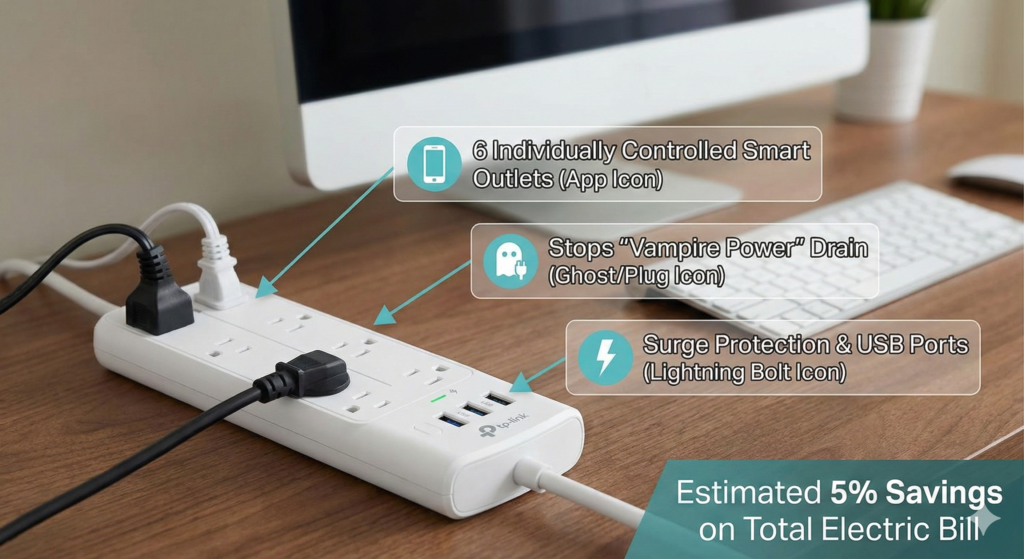
Why it saves electricity: Allows you to physically cut the circuit to secondary devices when they aren’t needed, eliminating standby power drain.
Ideal user: Anyone with a heavy PC setup, entertainment center, or home theater.
Key features: 6 individually controlled smart outlets, 3 USB ports, voice control, surge protection.
Pros: Monitor energy on each outlet, easy app setup, doubles as a surge protector.
Cons: A bit bulky for tight spaces behind furniture.
Real-life use case: Setting a schedule on the Kasa app so your gaming monitors, speakers, and LED lights completely cut power at 11 PM every night.
Estimated energy savings: Roughly 5% of your total power bill.
Price category: Budget / Mid
4. Emporia Smart Home Energy Monitor
Get real-time data on exactly what is driving up your bill.
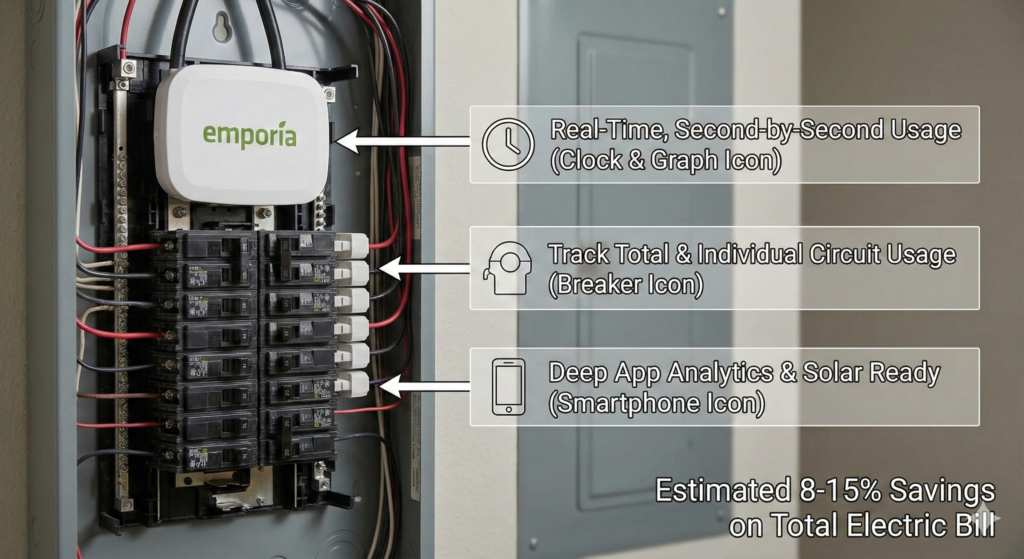
Why it saves electricity: You can’t manage what you don’t measure. Monitors clamp onto your electrical panel to track real-time, second-by-second usage.
Ideal user: Data-loving homeowners who want total transparency over their home’s power draw.
Key features: Tracks total usage plus individual circuits, solar/net-metering ready, deep app analytics.
Pros: Highly educational, helps identify failing or inefficient appliances early.
Cons: Requires professional or highly confident DIY installation inside your home’s breaker box.
Real-life use case: Opening your Emporia app and realizing your old basement freezer is costing you $15 a month to keep a single bag of ice cold—prompting you to finally unplug it.
Estimated energy savings: 8–15% (through changed behavior and identifying issues).
Price category: Premium
4. How to Reduce Your Electric Bill Without Renovations: The Budget Plan
Not everyone has the capital to upgrade all their appliances at once. Here is a strategic, tiered plan to reduce energy consumption at home based on your budget.
Tier 1: Under $100 (The Basic Upgrades)
If you have a strict budget, focus on the cheapest, highest-yield fixes.
- Buy a pack of LED bulbs to replace your 5 most-used lights.
- Purchase two smart power strips for your living room TV and your computer desk.
- Buy silicone weatherstripping tape and seal your front door and drafty windows.
- Impact: Immediate reduction in phantom loads and lighting costs.
Tier 2: Under $300 (Smart Home Starter Bundle)
Take automation into your own hands.
- USA: Buy a mid-range smart thermostat (like an Ecobee or Nest) to automate your central HVAC.
- Europe: Buy a smart radiator starter kit and equip your living room and bedroom radiators.
- Add a few individual smart plugs for standalone lamps or space heaters to ensure they never run accidentally.
- Impact: Major reduction in the largest energy drain (heating and cooling) with zero daily effort.
Tier 3: $500+ (Long-Term Investment)
For homeowners looking for deeper, structural savings.
- Install a whole-home energy monitor in your breaker box.
- Have a professional top up your attic insulation or seal ductwork.
- Upgrade a failing, 15-year-old appliance (like a refrigerator) to a modern, highly efficient model.
- Impact: Permanent structural reduction in your baseline energy requirements.
5. Comparison Table: Best Energy Saving Devices
| Product Category | Best For | Estimated Savings Potential | Price Range | Installation Difficulty |
| Smart Thermostat (HVAC) | US Homes / Central Air | 10–15% on HVAC | $100–$250 | Moderate (Wiring required) |
| Smart Radiator Valve | EU Apartments / Boilers | Up to 30% on Heating | $80–$150 | Easy (Unscrew & replace) |
| Smart Power Strip | Entertainment Centers | 5% on Total Bill | $20–$40 | Very Easy (Plug & play) |
| Energy Monitor | Data-driven Homeowners | 8–15% on Total Bill | $150–$300 | Hard (Panel work required) |
| LED Light Bulbs | Older Homes / Renters | Up to 90% per bulb | $10–$30 | Very Easy (Twist & go) |
6. Frequently Asked Questions
What uses the most electricity in a home?
In both the USA and Europe, heating and cooling are generally the largest consumers of electricity, accounting for nearly half of a standard home’s energy use. Following close behind are water heating systems, large kitchen appliances (refrigerators, electric ovens), and washing machines or dryers.
Does unplugging devices really save money?
Yes. “Vampire energy” or standby power occurs when devices are turned off but remain plugged in. Things like phone chargers, microwaves with digital clocks, and gaming consoles draw a small but continuous amount of power. Unplugging them, or using a smart power strip, can cut your power bill USA or Europe by 5% to 10% annually.
Are smart thermostats worth it?
For the vast majority of households, yes. Smart thermostats eliminate human error by automatically lowering the temperature when you are away or sleeping. Because heating and cooling make up such a massive portion of your bill, these devices often pay for themselves in energy savings within the first 12 to 18 months of use.
How much can I realistically save by using these tips?
While you should avoid guaranteed savings promises, a household that implements LED lighting, uses smart power strips, adjusts their thermostat behavior, and washes clothes in cold water can expect to reduce electricity bills by 15% to 25%. Heavy energy users who seal drafts and add smart thermostats may see savings closer to 30% or 40%.
Is electricity more expensive in Europe than USA?
Generally, yes. Due to different energy grid infrastructures, taxation, and import costs, the baseline cost per kilowatt-hour (kWh) in countries like Germany, the UK, or Italy is often significantly higher than the national average in the United States. This makes energy saving tips 2026 especially critical for European residents.
Do LED bulbs really reduce bills?
Absolutely. An old incandescent bulb uses around 60 watts to produce the same amount of light as a 9-watt LED bulb. If you have 20 bulbs in your house running for several hours a day, switching to LEDs is one of the fastest, most cost-effective ways to cut electricity costs.
Read Next on Smart Deal Finds:
- Smart Home Upgrades for Small Apartments That Actually Make Daily Life Easier
- 5 Practical Amazon Finds in 2026 That Actually Make Daily Life Easier
- 5 Best Amazon Home Organization Products That Save Space
7. Start Small, Save Consistently
You don’t need to implement all 12 of these tips today to start seeing a difference. The secret to reducing energy consumption at home is consistency.
Start small. Pick one or two affordable upgrades this month—perhaps swapping out your living room bulbs for LEDs or ordering a smart power strip for your TV setup. Next month, consider tweaking your thermostat schedule or investigating smart radiator valves for your apartment.
Over time, these incremental, budget-friendly changes will stack up, insulating you from the shock of winter heating costs and summer AC bills.
Disclaimer: This article is for informational purposes only. Energy savings vary depending on usage, home size, local climate, and location utility rates.