
Small Space, Big Potential
Living in a small apartment often feels like a constant negotiation with space. You love the cozy vibe and the lower rent, but the daily frustrations are real. There’s the clutter that accumulates on the one available counter, the struggle to reach a power outlet behind the sofa, or the harsh overhead lighting you can’t change because you’re renting.
If you are a student in a dorm, a young professional in a studio in Berlin, or a couple sharing a one-bedroom in New York, you know the drill: you want a modern, convenient lifestyle, but you can’t drill holes in the walls or spend thousands on a full renovation.
Here is the good news: Smart home upgrades for small apartments have evolved massively by 2026. Gone are the days of clunky hubs and complex wiring. Today’s smart tech is compact, wireless, and designed specifically for flexible living.
Imagine waking up to lights that gently fade on, a coffee maker that starts brewing before you leave bed, and a vacuum that cleans the tight corners under your bed while you’re at work. These aren’t just gadgets; they are tools to reclaim your time and mental space.
In this guide, we are skipping the expensive, permanent fixtures. Instead, we are focusing on renter-friendly, affordable smart home gadgets for 2026 that require zero drilling and deliver maximum convenience. Let’s turn your compact living space into a smart sanctuary.
Disclaimer: This post contains affiliate links. As an Amazon Associate, I earn from qualifying purchases at no extra cost to you. I only recommend products I truly believe will make small apartment living easier!
The Best Smart Home Upgrades for Small Apartments (2026)
We have curated a list of the most practical devices that respect your limited square footage while upgrading your daily routine.
The “Do-It-All” Smart Plug (Matter-Enabled)
Turn any “dumb” appliance into a genius helper instantly.
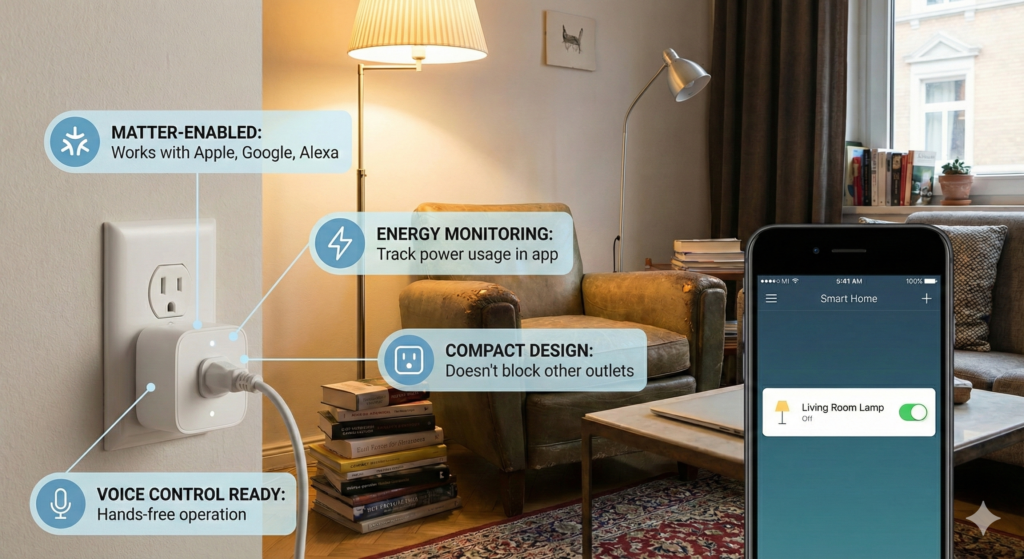
Why it’s perfect for small apartments: Smart plugs are the gateway drug to smart home living. They are tiny, stackable, and move with you when you swap apartments. In 2026, with Matter support standard, they work with Apple, Google, and Alexa seamlessly.
Real-life daily use: Plug your floor lamp into one. Now, instead of stumbling in the dark to find the switch behind the armchair, you just say, “Turn on the living room.” Or, connect your hair straightener to one so you never have to panic-commute home wondering if you left it on—you can just check the app and cut the power remotely.
Key Features:
- Energy Monitoring: See exactly how much power that space heater is using.
- Scheduling: Set lamps to turn on at sunset automatically.
- Compact Design: Doesn’t block the second outlet.
- Voice Control: Hands-free operation when your hands are full of groceries.
Pros & Cons:
- Pros: extremely affordable, easy setup, works with old appliances.
- Cons: bulky plugs can sometimes fit awkwardly behind tight furniture.
Who should buy this: Everyone. It is the cheapest way to start automating.
Renter-Friendly Smart Lighting Starter Kit
Set the mood without calling an electrician.
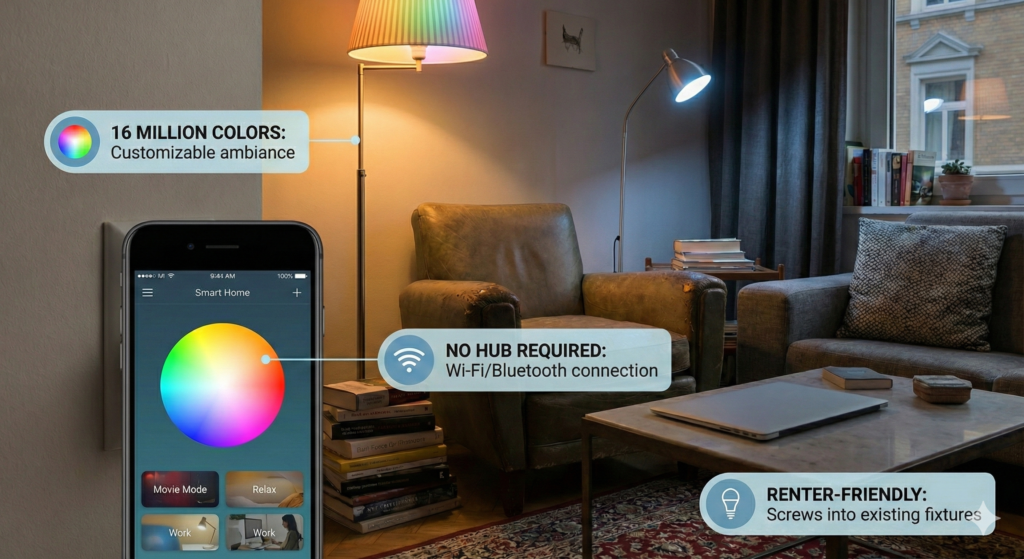
Why it’s perfect for small apartments: Harsh rental lighting is a mood killer. Smart bulbs screw into existing fixtures, meaning no wiring is required. In a studio, changing the light color can visually separate “work time” (cool white) from “relax time” (warm amber), effectively creating two rooms out of one.
Real-life daily use: It’s movie night. Instead of getting up to hit the switch, you tap “Movie Mode” on your phone. The main lights dim to a deep blue, and the strip lights behind your TV glow softly, making your 400-square-foot apartment feel like a private cinema.
Key Features:
- 16 Million Colors: Customizable ambiance.
- Circadian Rhythm Sync: Lights adjust automatically to match daylight.
- No Hub Required: Connects directly via Wi-Fi or Bluetooth.
- Music Sync: Lights pulse to the beat of your playlist.
Pros & Cons:
- Pros: Instant atmosphere change, energy-efficient LED, app control.
- Cons: Can be pricey to replace every bulb in the house.
Who should buy this: Renters stuck with bad overhead lighting or studio dwellers.
Compact Robot Vacuum & Mop Combo
Keep your floors pristine without losing closet space.
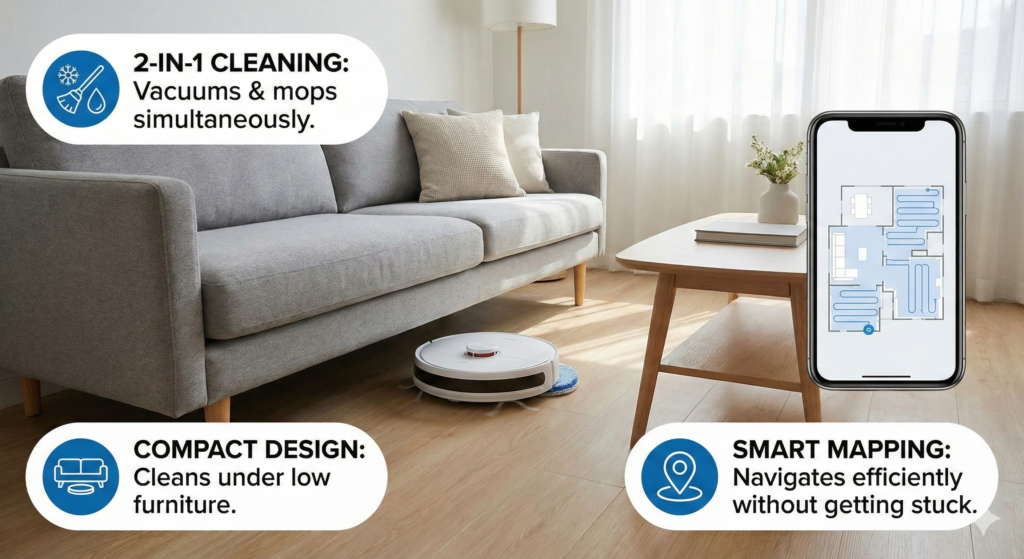
Why it’s perfect for small apartments: Floor space is premium real estate. You don’t have room for a clunky upright vacuum and a bucket/mop. Modern compact robot vacuums are designed to slide under low-profile furniture (like that IKEA sofa) and dock in tight corners.
Real-life daily use: You leave for work at 8:00 AM. By 8:15 AM, your robot wakes up, vacuums the crumbs from breakfast, and mops the entryway where you tracked in mud. You come home to spotless floors every single day without lifting a finger.
Key Features:
- LiDAR Mapping: Maps your apartment so it doesn’t fall down stairs or hit the cat bowl.
- 2-in-1 Cleaning: Vacuums and mops simultaneously.
- Quiet Mode: ideal for thin apartment walls; won’t annoy neighbors.
- Self-Emptying Station: (Optional) holds weeks of dust.
Pros & Cons:
- Pros: Huge time saver, keeps dust allergies at bay, compact footprint.
- Cons: Higher upfront cost; small dustbins need frequent emptying if you don’t get the dock.
Who should buy this: Pet owners or busy professionals who hate cleaning.
SwitchBot Smart Curtain Opener
Wake up to natural sunlight, not an alarm clock
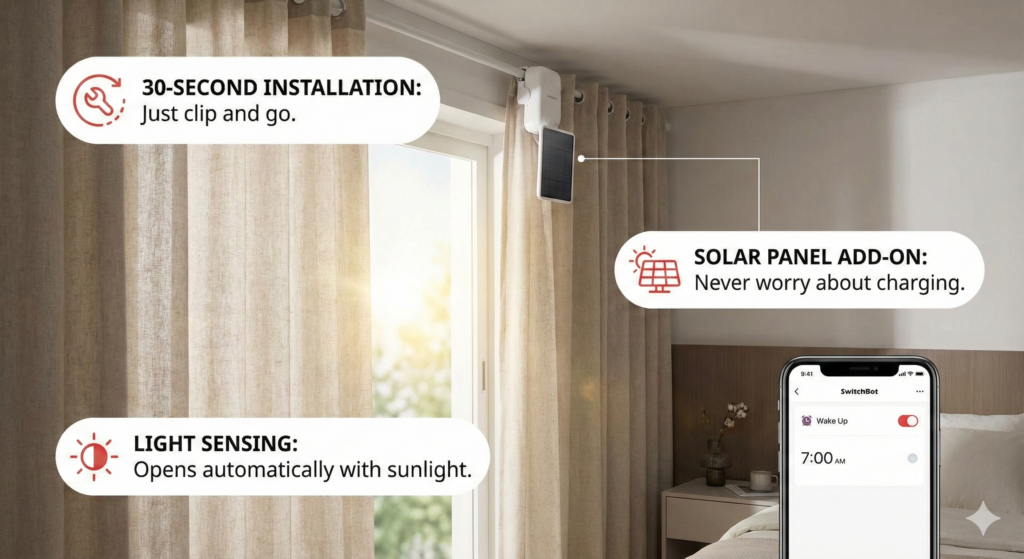
Why it’s perfect for small apartments: This is the ultimate “luxury on a budget” item. It is a small robot that clips onto your existing curtain rail. No screws, no drilling, no changing your curtains. It’s surprisingly effective for making a small room feel larger by letting light in automatically.
Real-life daily use: You set a schedule for 7:00 AM. The bot silently pushes your curtains open, letting natural light wake you up gently. When you leave for work, it closes them to keep the apartment cool and secure.
Key Features:
- 30-Second Installation: Just clip and go.
- Solar Panel Add-on: Never worry about charging the battery.
- Light Sensing: Closes automatically if the sun gets too hot.
- Universal Fit: Works on rod, U-rail, and I-rail tracks.
Pros & Cons:
- Pros: innovative, improves sleep quality, theft deterrent (looks like someone is home).
- Cons: motor noise can be audible if set to high speed.
Who should buy this: Heavy sleepers and people concerned with privacy/security.
Smart Air Purifier with App Control
Clean air is essential in smaller, enclosed spaces.
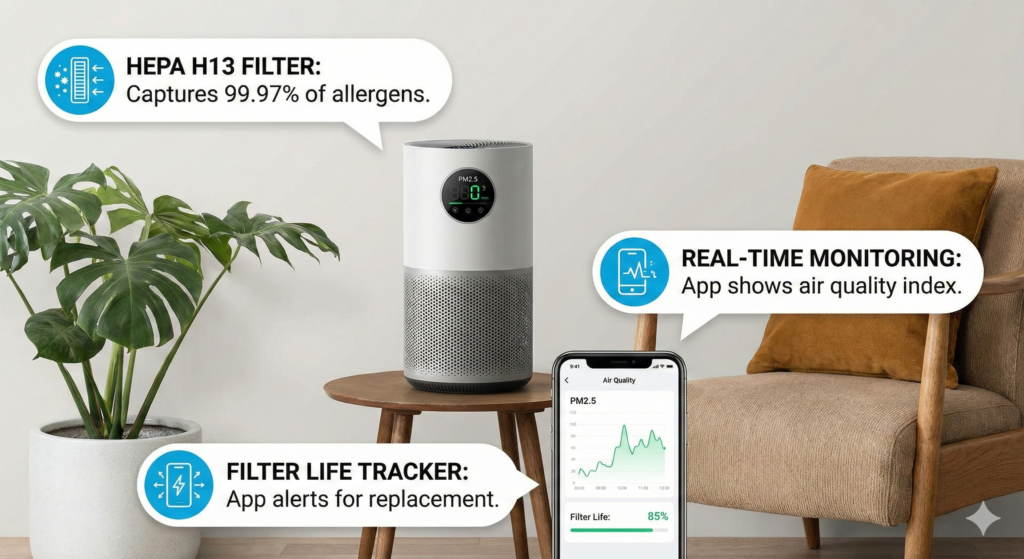
Why it’s perfect for small apartments: Small spaces trap odors—cooking smells, pet dander, or city pollution—much faster than large houses. A smart air purifier monitors air quality in real-time and ramps up when you burn the toast, ensuring your limited square footage doesn’t smell like burnt bread all day.
Real-life daily use: You are frying onions for dinner. The sensor detects the spike in particles and automatically switches to “High” mode. By the time you sit down to eat, the air is crisp and odor-free. You can also check the air quality from your office to ensure it’s fresh for your return.
Key Features:
- HEPA H13 Filter: Captures 99.97% of dust and allergens.
- Real-Time Monitoring: App shows current air quality index (AQI).
- Sleep Mode: Turns off display lights and runs whisper-quiet.
- Filter Life Tracker: App tells you exactly when to order a replacement.
Pros & Cons:
- Pros: Reduces allergies, eliminates odors, modern aesthetic.
- Cons: Filter replacements are an ongoing cost.
Who should buy this: Allergy sufferers, pet owners, or city dwellers.
Video Doorbell (No-Drill/Peep-Hole Version)
Security that doesn’t risk your security deposit.
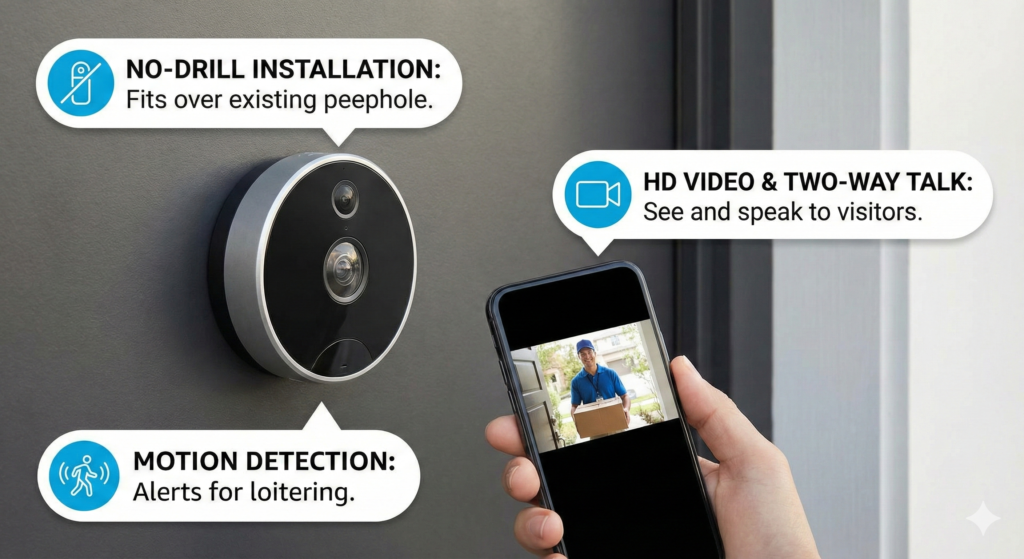
Why it’s perfect for small apartments: Standard video doorbells require wiring or drilling into the door frame—a big “no” for renters. The peep-hole or adhesive battery-powered versions fit over your existing peephole or stick to the frame, giving you smart security that is 100% reversible.
Real-life daily use: You are in a meeting when the delivery driver buzzes. You get a notification on your phone, see who it is, and use two-way audio to tell them, “Please leave the package behind the planter.” No missed deliveries, no opening the door to strangers.
Key Features:
- HD Video: Clear view of your hallway or doorstep.
- Two-Way Talk: Speak to visitors via your phone.
- Motion Detection: Alerts you if someone loiters outside your door.
- Easy Install: unscrew old peephole, slide this in.
Pros & Cons:
- Pros: Great security, easy to remove when moving, package theft prevention.
- Cons: Battery needs recharging every few months; relies on strong Wi-Fi near the door.
Who should buy this: Solo renters and online shopping addicts.
Bedside Smart Charging Station & Hub
Declutter your nightstand and wake up fully charged.
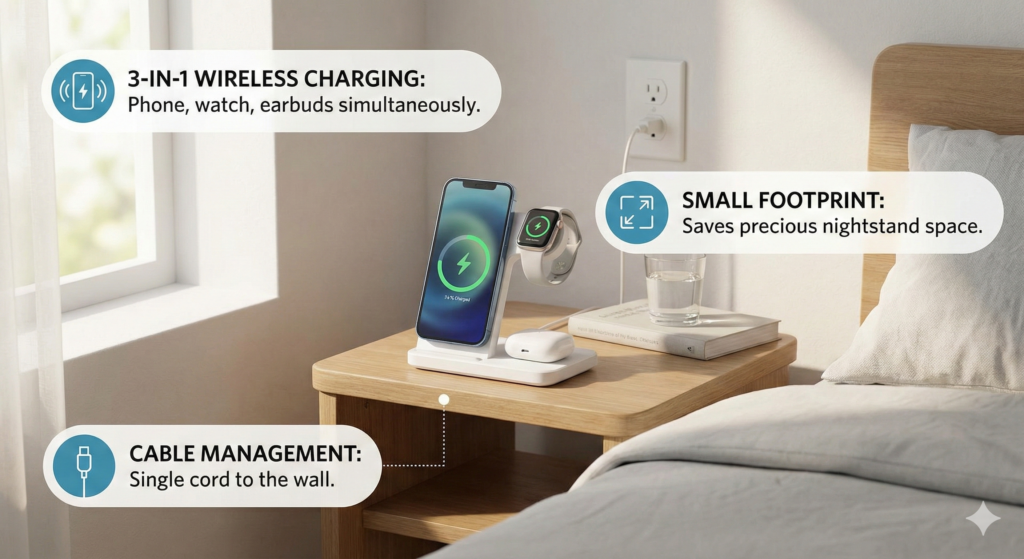
Why it’s perfect for small apartments: In a small bedroom, the nightstand is often the only surface. Cables for your phone, watch, and earbuds create instant clutter. A 3-in-1 smart station organizes everything vertically, saving precious surface area.
Real-life daily use: You drop your phone, watch, and earbuds onto the magnetic stand before sleep. No fumbling for cables in the dark. Some models even include a built-in smart light that mimics a sunrise for a gentle wake-up.
Key Features:
- Fast Wireless Charging: MagSafe compatible.
- Small Footprint: Vertical design saves space.
- Cable Management: Single cable goes to the wall.
- Overheat Protection: Safe for overnight charging.
Pros & Cons:
- Pros: aesthetically pleasing, reduces cable mess, convenient.
- Cons: Charging is slightly slower than a wired fast charger.
Who should buy this: Minimalists and tech lovers with multiple devices. Price Category: Budget ($)
3. How to Choose Smart Home Devices for Small Apartments
Before you fill your cart, keep these “small space” criteria in mind to avoid buyer’s remorse.
1. Wi-Fi Compatibility (2.4GHz vs. 5GHz) Many smart devices still run on 2.4GHz networks. Ensure your router can handle multiple devices. In apartment complexes with crowded Wi-Fi channels, devices that support Thread or Zigbee (which create their own mesh network) are often more reliable than pure Wi-Fi gadgets.
2. Space Efficiency Always ask: “Where will this live?” Avoid devices that require a dedicated hub plugged into your router if you can avoid it. Look for “hub-free” or “Matter-enabled” devices that connect directly to your existing ecosystem (Apple Home, Google Home, or Alexa).
3. Multi-Functionality In a small apartment, single-use gadgets are clutter. A smart speaker that is also a clock and a Wi-Fi extender (like the Eero or newer Echo Dot) is far more valuable than just a speaker.
4. Renter-Friendly Installation If it requires a drill, skip it. Look for keywords like “adhesive mount,” “freestanding,” “plug-in,” or “clamp-on.” You want to be able to pack your smart home in a box when your lease ends, leaving no trace behind.
5. Noise Level In a 400 sq ft studio, a loud robot vacuum or air purifier is inescapable. Check decibel (dB) ratings. Anything under 50dB is generally acceptable for shared living spaces.
4. Budget Plan: Smart Upgrades Under $300
You don’t need to be rich to have a smart home. Here is how to allocate your budget for maximum impact.
The “Starter” Bundle (Under $100)
Focus: Convenience & Lighting
- 2x Smart Plugs ($20) – For lamps and fans.
- 2x Smart Light Bulbs ($25) – For main room ambiance.
- 1x Smart Speaker (Echo Dot or Nest Mini) ($40) – Voice control center.
- Total: ~$85
The “Efficiency” Bundle (Under $200)
Focus: Energy Saving & Comfort
- Everything in the Starter Bundle ($85)
- 1x SwitchBot Curtain Opener ($80) – Natural wake-up.
- 1x Smart Humidity/Temp Sensor ($15) – Monitor apartment health.
- Total: ~$180
The “Automation” Bundle (Under $300)
Focus: Full Experience
- Everything in the Efficiency Bundle ($180)
- 1x Budget Robot Vacuum (e.g., Eufy or specialized budget brand) ($110)
- Total: ~$290
5. Comparison Table: At a Glance
| Product | Best For | Price Range | Space Required | Installation Difficulty |
| Smart Plug | Automating “dumb” lamps/fans | $ (Low) | Tiny (Outlet) | Very Easy |
| Smart Bulb | Mood lighting & ambiance | $$ (Mid) | None (Existing socket) | Very Easy |
| Robot Vac/Mop | Floor cleaning | $$$ (High) | Floor Dock (1 sq ft) | Easy |
| SwitchBot Curtain | Natural light & waking up | $$ (Mid) | None (Curtain rod) | Easy |
| Smart Air Purifier | Allergy relief & odors | $$ (Mid) | Floor/Table corner | Very Easy |
| Video Doorbell | Security & packages | $$ (Mid) | Door Peep-hole | Moderate |
| Charging Station | Nightstand organization | $ (Low) | Nightstand surface | Very Easy |
6. Frequently Asked Questions (FAQ)
Are smart home upgrades worth it in small apartments? Absolutely. In small spaces, minor inconveniences (like poor lighting or clutter) feel magnified. Smart upgrades allow you to control your environment efficiently, save energy, and utilize space better without physical clutter. The mental relief of a well-automated home is worth the investment.
Can renters install smart home devices? Yes, as long as you choose non-permanent solutions. Stick to devices that plug in, use adhesive strips (like Command strips), or replace existing items without wiring (like light bulbs or peep-hole cameras). Avoid smart switches that require messing with electrical wiring or smart locks that require changing the deadbolt unless you have landlord permission.
Do smart plugs increase electricity bills? Smart plugs use a negligible amount of electricity (often less than 1 watt) to stay connected to Wi-Fi. Conversely, they usually save you money by allowing you to schedule high-energy appliances to turn off automatically or monitor “vampire power” devices that drain energy even when off.
What is the best smart device for a studio apartment? A smart speaker (like Amazon Echo or Google Nest) combined with smart lighting is the most impactful upgrade for a studio. Since your bedroom, living room, and office are often the same room, using voice commands to change lighting scenes (“Work Mode” vs. “Relax Mode”) helps mentally separate your day.
Do I need a “Hub” for these devices? In 2026, fewer devices require dedicated hubs thanks to the Matter protocol. Most modern devices connect directly via Wi-Fi or Bluetooth. However, if you plan to have 20+ devices, a dedicated hub (like a SmartThings hub or an Echo Show with Zigbee built-in) can help keep your Wi-Fi network uncongested.
7. Conclusion: Start Small, Think Smart
Transforming your small apartment into a smart home doesn’t have to be overwhelming or expensive. It’s not about buying every gadget on the market; it’s about solving the little frictions in your day.
Maybe it’s just one smart plug that turns off your heater after you leave, or a set of lights that makes your rental feel like home. These small changes add up to significant daily comfort.
Ready to upgrade? Start with just one or two items from the list above—perhaps the smart plug or the lighting kit—and experience the difference for yourself. Your small space is about to feel a whole lot bigger.