
The Ultimate Guide to Home Organization: 5 Amazon Products That Actually Save Space
Clutter usually does not happen because people are lazy or careless. It happens simply because life gets busy. Shoes pile up near the entryway, kitchen cabinets get stuffed with cleaning supplies, and closet shelves eventually overflow with seasonal clothes. No matter how much you tidy on the weekend, the mess seems to return by Tuesday.
This is a common struggle for homeowners and renters across the USA, Europe, and the UK. When we feel crowded, our first instinct is often to buy bigger furniture. We think, “If I just had a larger wardrobe, this wouldn’t be a problem.”
However, buying bulky furniture is often a mistake. It makes the room feel tighter and consumes valuable floor space. What most modern homes really need is smarter storage, not just more storage.
In this comprehensive guide, I will walk you through practical, high-rated home organization products on Amazon that solve these specific problems. These are not just trendy items; they are engineering solutions designed to maximize the “dead space” in your home.
Whether you are living in a compact city apartment or a suburban family home, these tools will help you reclaim your space without a renovation.
(Disclaimer: This article contains affiliate links. If you purchase through these links, we may earn a small commission at no extra cost to you. This helps support our blog and allows us to create more free guides.)
1. The Vertical Solution: Over-the-Door Hanging Organizers
Best For: Renters, students, small bedrooms, and pantries.
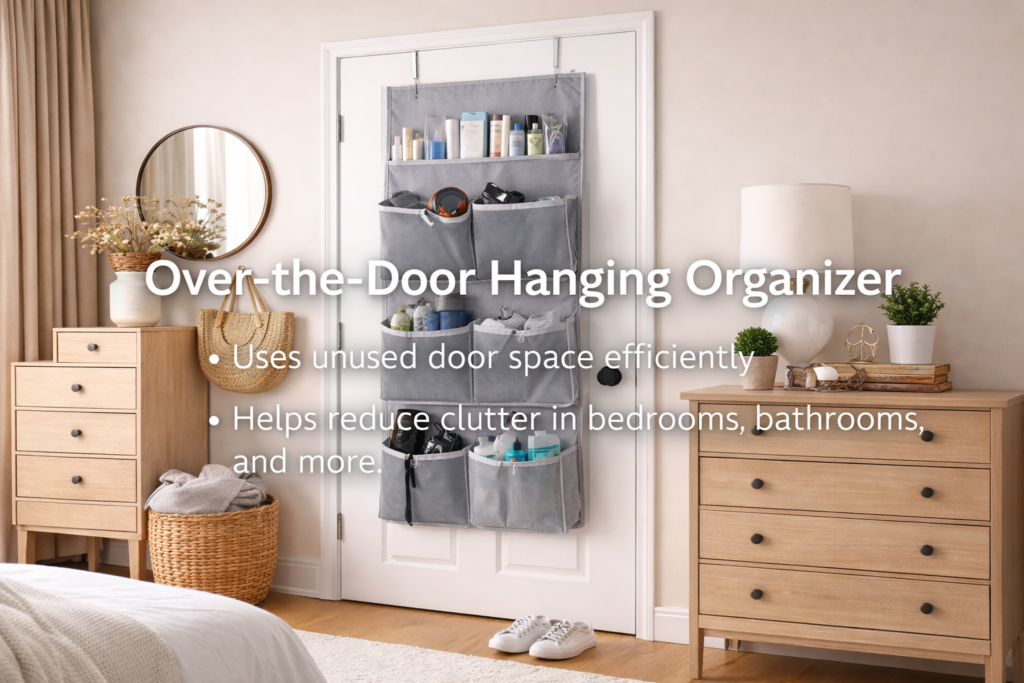
Most people look at a door and just see a way to enter or exit a room. In reality, the back of a door is prime real estate for storage. An over-the-door hanging organizer is a vertical unit that hooks onto the top of a door, utilizing space that is otherwise wasted.
Why It Solves the Space Issue
Floor space is expensive. If you place a shoe rack on the floor, you lose square footage. On the other hand, if you hang an organizer behind the door, you lose zero floor space. This is critical for small entryways or bedrooms where every inch counts.
Technical Breakdown: What to Look For
Not all organizers are created equal. When browsing Amazon, you need to look at specific technical details to ensure you don’t buy a product that rips in a month.
- Material Strength (GSM): Look for “Non-woven fabric” or “600D Oxford Cloth.”
- Why this matters: “600D” refers to the denier (thickness) of the fabric. Specifically, a higher number means it is resistant to tearing, even if you store heavy items like tools or large shampoo bottles.
- Hook Design & Door Gap: Standard interior doors in the US and Europe are typically 1-3/8 inches to 1-3/4 inches thick.
- The Connector: You need a metal bracket that is thin enough (usually under 1.5mm) to allow the door to close, but strong enough not to bend.
- Breathability: If you are storing shoes, you want mesh pockets.
- The Science: Shoes carry moisture and bacteria. Mesh allows air to circulate, preventing odors and mold growth, which is a common issue with plastic pockets.
How to Use It (Beyond Shoes)
Furthermore, while these are sold as “shoe organizers,” their utility goes much further:
- The Pantry Door: Store snacks, spice jars, and foil rolls.
- The Cleaning Closet: Perfect for spray bottles, sponges, and brushes.
- The Bathroom: Ideal for hair dryers, lotions, and extra toilet paper.
Buying Decision Trigger: If you have more items than shelves, and you cannot drill holes in your walls (perhaps because you are renting), this is the single most effective “no-install” solution available.
2. The Closet Multiplier: Stackable Storage Bins
Best For: Deep closets, wardrobes with few shelves, and laundry rooms.
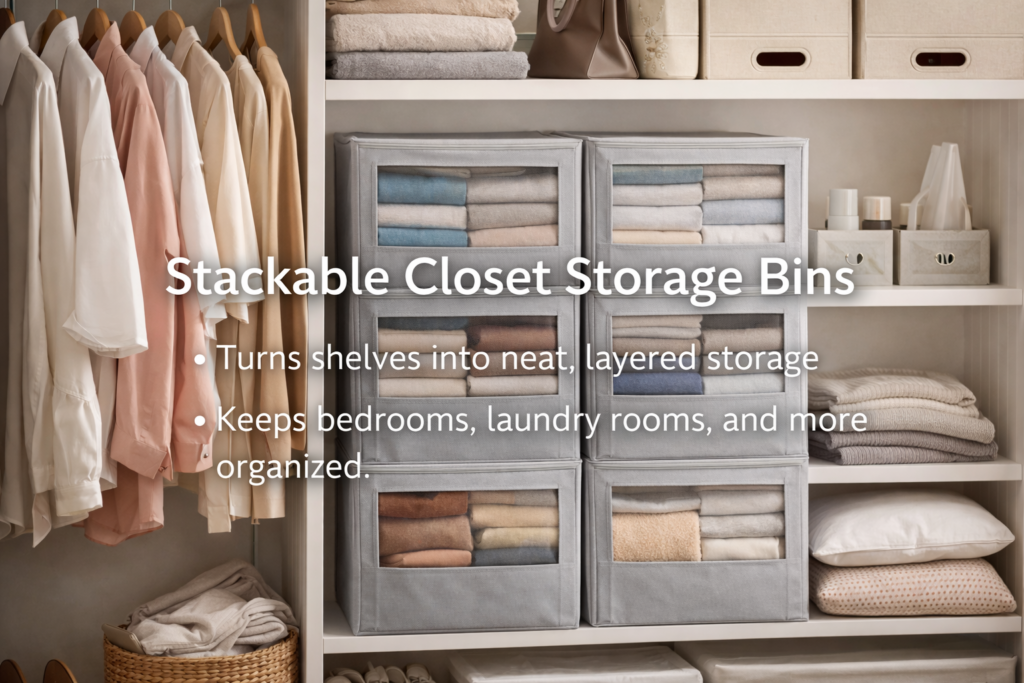
Have you ever noticed that standard closet shelves are often spaced 12 to 18 inches apart? Yet, a stack of t-shirts is only 5 inches high. This leaves 7 to 13 inches of “dead air” above your clothes that does nothing but collect dust.
Stackable bins solve this by creating drawers where none existed before.
The Mechanics of Modular Storage
“Modular” means these units can be combined. You can stack them four high in a tall closet or two high under a desk. Unlike a wooden dresser, you can change the configuration whenever you move or reorganize.
Technical Details to Check
- Slide Rails: This is the most important feature.
- The Feature: Look for bins that have a “drawer” function, meaning the box slides out while the frame stays stacked.
- Why it matters: Without rails, you have to unstack the top boxes to reach the bottom one. That is inconvenient and leads to messiness.
- Material Composition: Polypropylene (PP) Plastic.
- The Benefit: PP is food-safe, odorless, and incredibly durable. Unlike fabric bins, rigid plastic won’t sag over time. It is also waterproof, making it safe for humid areas like bathrooms.
- Interlocking Clips: Good models have small clips or grooves on the top and bottom rims. This ensures the stack doesn’t topple over when you pull a drawer open.
Real-World Application
- In the Wardrobe: Use them to separate categories—jeans in one, workout gear in another.
- Under the Bathroom Sink: Great for containing small items like cotton swabs, razors, and soaps that usually get lost in deep cabinets.
- Home Office: Perfect for printer paper, cables, and stationery.
Buying Decision Trigger: If you have tall shelves and find yourself piling clothes in unstable towers that fall over, stackable bins will instantly structure your space.
3. The Plumbing Hack: Expandable Under-Sink Organizers
Best For: Kitchen cabinets and bathroom vanities.
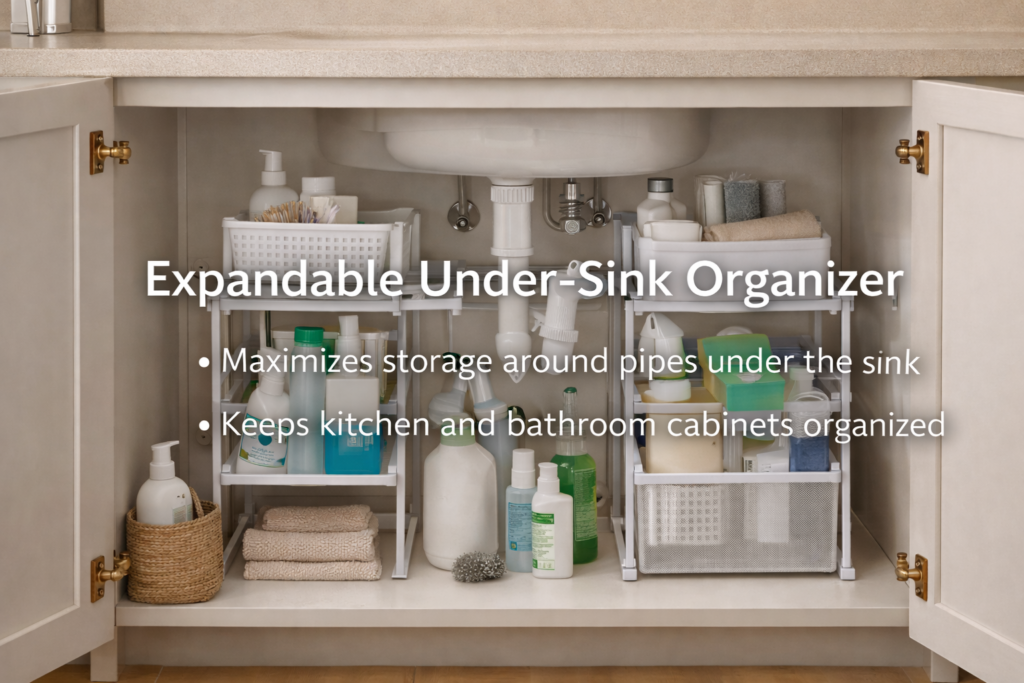
The cabinet under the kitchen sink is often the most chaotic place in the home. Why? Because of the P-trap (the U-shaped plumbing pipe). This pipe prevents you from installing a standard shelf, leaving you with a messy pile of cleaning supplies.
The Engineering Solution
An expandable under-sink organizer is designed specifically to navigate this obstacle. It features a gap in the middle or removable shelf panels to accommodate the pipe.
Technical Breakdown
Telescopic Rails: Look for a unit that expands horizontally (typically from 15 inches to 25 inches). Kitchen cabinets vary wildly in width. Therefore, an expandable unit ensures a custom fit without measuring down to the millimeter.
Vertical Adjustability: The ability to move the shelf height up or down by 1-2 inches makes a huge difference when fitting tall bleach bottles versus short sponges.
Load Bearing: Cleaning fluids are heavy. Look for a unit rated for at least 40 lbs (18 kg). Stainless steel support poles are superior to plastic ones for this reason.
Installation & Use
This is one of the few items that requires assembly, but it is usually tool-free.
- Clear the cabinet completely.
- Assemble the frame inside the cabinet (sometimes the assembled unit is too wide to fit through the door).
- Adjust the width to avoid the pipes.
- Snap the plastic shelf panels on, leaving a gap where the pipe runs.
Buying Decision Trigger: If you currently have to take 5 items out of your cabinet just to reach the dishwasher tablets at the back, this product will save you frustration every single day.
4. The Volume Shrinker: Vacuum Storage Bags
Best For: Seasonal clothing, guest bedding, pillows, and moving.
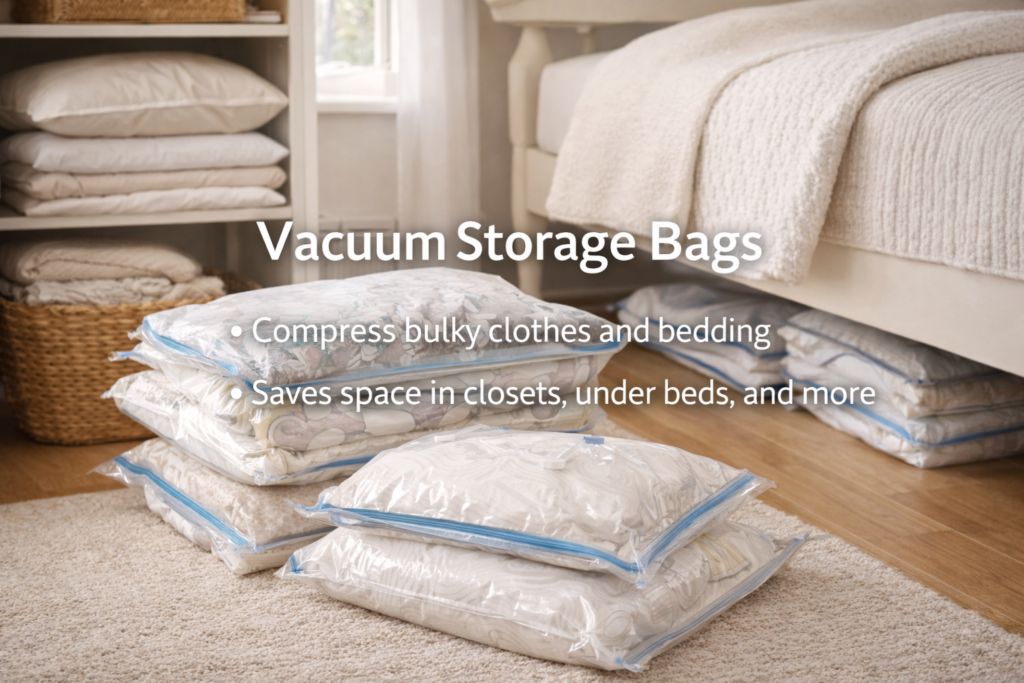
Storage isn’t just about where you put things; it’s about how big those things are. Winter coats, duvets, and pillows are 80% air. Vacuum storage bags remove that air, compressing bulky items into flat, hard discs.
The Physics of Compression
By using a standard vacuum cleaner hose (or an included hand pump), you suck the air out of the bag. Atmospheric pressure then crushes the contents down. A stack of four fluffy pillows can be reduced to the size of one.
Technical Details to Check
This is a product where quality matters. Cheap bags leak air and re-inflate after a week.
Micron Thickness: Look for bags that are 0.09mm (90 microns) or thicker. Standard grocery bags are often 0.02mm. Consequently, thinner bags will puncture if dragged across a floor.
The Double-Zip Seal: The top closure should have two lines of “zipper” tracks. Many brands use color-changing zippers (e.g., pink turns to yellow when sealed) to visually confirm the bag is airtight.
The Turbo Valve: Ensure the valve has a “triple-seal” gasket to prevent air from rushing back in the moment you remove the vacuum hose.
Preservation & Safety
A common question is: Does this damage clothes? Generally, no. It actually protects them from:
- Moths and Insects: They cannot survive without air.
- Moisture and Mold: The airtight seal keeps fabrics dry.
- Dust: Items come out as clean as they went in.
Note: For natural fibers like wool or down feathers, it is recommended not to suck all the air out. Instead, leave about 20% air to prevent damaging the natural structure of the fibers.
Buying Decision Trigger: If your closet is full of winter coats in the middle of July, or if you are running out of space for guest bedding, this is the most cost-effective solution.
5. The Drawer Savior: Honeycomb or Adjustable Dividers
Best For: Underwear, socks, ties, and “junk drawers.”
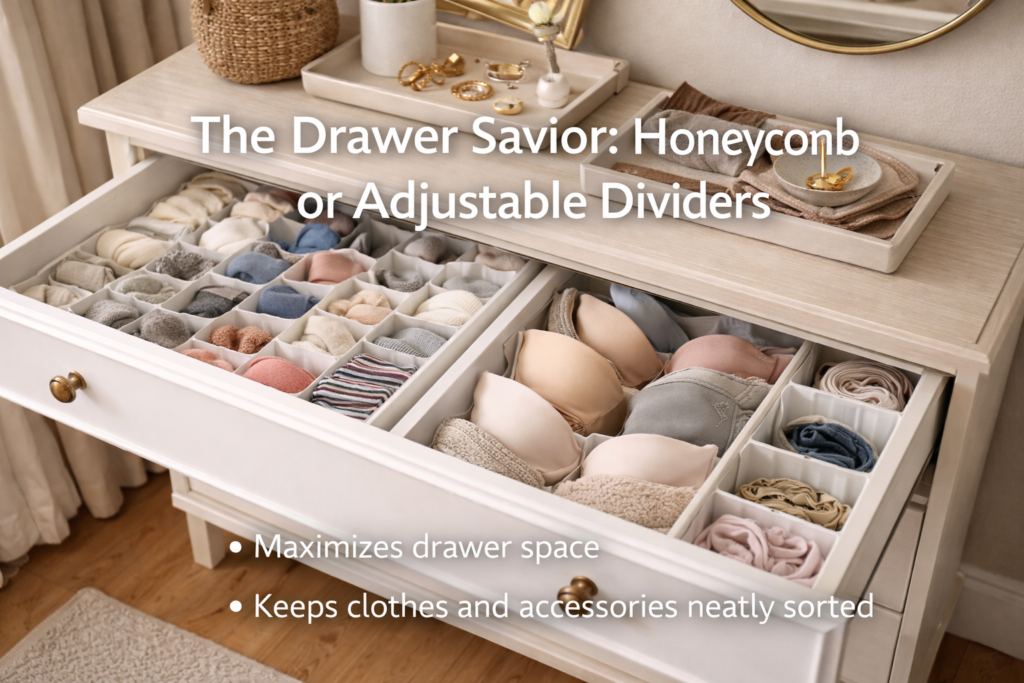
Throwing small items into a large drawer creates a “soup” of clutter. You dig through socks to find underwear, or through cables to find a battery.
The Logic of Compartmentalization
Dividers force you to assign a specific “home” to each item. When an item has a dedicated slot, you are psychologically more likely to put it back in the right place.
Technical Options
- Honeycomb Dividers: Ideally made of flexible plastic that snaps together. These create honeycomb-shaped slots perfect for socks and belts.
- Spring-Loaded Dividers:
- The Mechanism: These look like wooden bars. They have a spring inside that pushes against the front and back of the drawer.
- Stability: Look for dividers with EVA foam pads on the ends. This prevents the divider from scratching your furniture and keeps it from sliding around.
Buying Decision Trigger: If you dread opening your sock drawer or junk drawer, these dividers turn chaos into a display case.
Buyer’s Guide: How to Choose the Right Product
Before you rush to checkout, take a moment to assess your specific needs. Here is a simple framework to help you decide.
1. Measure Twice, Buy Once
It sounds obvious, but it is the number one reason for returns.
- For Under-Sink Organizers: Measure not just the width, but the depth and the height clearance of your drain pipe.
- For Door Organizers: Check the gap at the top of your door. Put a coin on top of your door and close it. If the coin falls off, the gap might be too tight for standard hooks.
2. Material Matters
- In the Bathroom: Always prioritize plastic or stainless steel. Wood and fabric will absorb moisture and may develop mold.
- In the Bedroom: Fabric (breathable) is best for clothes to keep them fresh. Rigid plastic is best for heavy items.
3. The “Rental Friendly” Factor
All the products listed in this guide are “non-invasive.” They do not require drilling holes, gluing, or permanent modification. This ensures you get your security deposit back when you move.
Frequently Asked Questions (FAQ)
Q: Will over-the-door organizers damage my door frame?
A: Generally, no. However, if the metal hooks are thick and your door gap is tight, it can scrape the paint. Tip: Apply a small piece of masking tape or felt padding to the underside of the hook to protect your door frame.
Q: Can vacuum bags be reused?
A: Yes, high-quality bags can be reused for years. The key is to handle the zipper area gently and avoid dragging the bags over sharp surfaces or zippers on clothes.
Q: Are these products available in the UK and EU?
A: Yes. Although brand names may differ slightly (e.g., a US brand might be “Rubbermaid” while an EU brand is “Songmics”), the product types—hanging organizers, vacuum bags, stackable bins—are universal standard goods available on all local Amazon sites.
Q: Do stackable bins tip over?
A: If you stack them too high, yes. A good rule of thumb is not to stack higher than 4 units for lightweight items, or 3 units for heavy items. Always place the heaviest items in the bottom bin to lower the center of gravity.
Final Verdict
Creating a spacious, organized home doesn’t require a contractor or a massive budget. It requires looking at your space differently.
- Look Up: Use the vertical space in your closet with Stackable Bins.
- Look Behind: Use the dead space behind doors with Hanging Organizers.
- Look Under: Reclaim the space under your sink with Expandable Shelves.
- Compress: Shrink your seasonal bulk with Vacuum Bags.
Home organization is a journey, not a one-time event. My advice? Start with one problem area. Don’t try to organize the whole house in a day. Pick the area that frustrates you the most—perhaps the entryway shoes or the under-sink chaos—and apply one of these solutions.
The peace of mind that comes from a tidy home is worth every penny.