
When Every Inch Feels Too Small
If you’ve ever moved into a small apartment, dropped your boxes, and immediately thought, “Where does the sofa even go?”—you are certainly not alone.
In fact, decorating a compact living space is a universal challenge. Whether you are settling into a modern apartment in the USA or a classic flat in Europe, small living rooms inevitably come with a frustrating set of built-in hurdles. For instance, you might be dealing with tight seating arrangements, awkward structural corners, or a severe lack of usable wall space. On top of that, you often have to work around windows placed in inconvenient spots and built-in storage that barely exists.
Because of these quirks, a common scenario usually plays out: you buy a sofa that looks absolutely perfect in a spacious furniture store showroom. However, the moment you bring it home, your main walkway completely disappears. Suddenly, the TV blocks your only window, and the coffee table becomes a daily obstacle course just to reach the kitchen.
So, what is the actual truth behind making a compact room work? As it turns out, in smaller homes, your layout matters significantly more than your total square footage.
Therefore, this 2026 guide will walk you through practical, renter-friendly small apartment living room layout ideas. By the end of this post, you will know exactly how to improve your daily flow, maximize your usable space, and make your room feel substantially larger—all without needing major renovations or an oversized budget.
Disclaimer:
As an Amazon Associate, I earn from qualifying purchases. This means if you click on an affiliate link and make a purchase, Smart Deal Finds may earn a small commission at no extra cost to you. We only recommend products we genuinely believe will help you save money.
Why Layout Matters More Than Furniture Size
When faced with a tight space, most people naturally assume that buying smaller furniture will automatically solve their problems.
However, it usually doesn’t.
In reality, a poorly arranged room filled with tiny, dollhouse-sized furniture can actually feel much more cramped and cluttered than a carefully planned room utilizing a standard, full-size sofa. To understand exactly why this happens, we need to look at the three core pillars of good room design.
1. Flow Is Everything
First and foremost, in small spaces, you need clear, unobstructed walking paths to maintain a sense of order. When planning your arrangement, keep these standard measurements in mind:
- 24–30 inches (60–75 cm): This is the absolute minimum required for tight, secondary walkways.
- 30–36 inches (75–90 cm): Meanwhile, this is the ideal width for your main traffic areas.
Ultimately, when your furniture blocks natural movement, the room will constantly feel chaotic and stressful, even if it is perfectly tidy.
2. Visual Balance Creates Calm
Similarly, a room naturally feels bigger and more inviting when the visual weight is managed properly. This balance is achieved when large items are distributed evenly across the space, rather than being clustered heavily against one wall. Consequently, the eye can move smoothly around the room without interruption. Furthermore, incorporating “negative space”—or empty breathing room—around your furniture gives the convincing illusion of a larger floor plan.
3. Think Like a Renter
Finally, as a renter, you face specific structural limitations. You generally cannot move walls, install custom built-ins, or drill excessively into the drywall. Therefore, your layout must rely entirely on clever, non-permanent workarounds. This means utilizing flexible furniture, taking full advantage of vertical space, and choosing lightweight, multi-use items. In short, function must always come first, while decoration comes second.
9 Practical Small Apartment Living Room Layout Ideas
Now that we understand the basics, let’s explore how to arrange your specific space.
1. The Floating Sofa Layout
Best for: One-bedroom apartments and rectangular rooms (10×12 ft / 3×3.6 m and up).
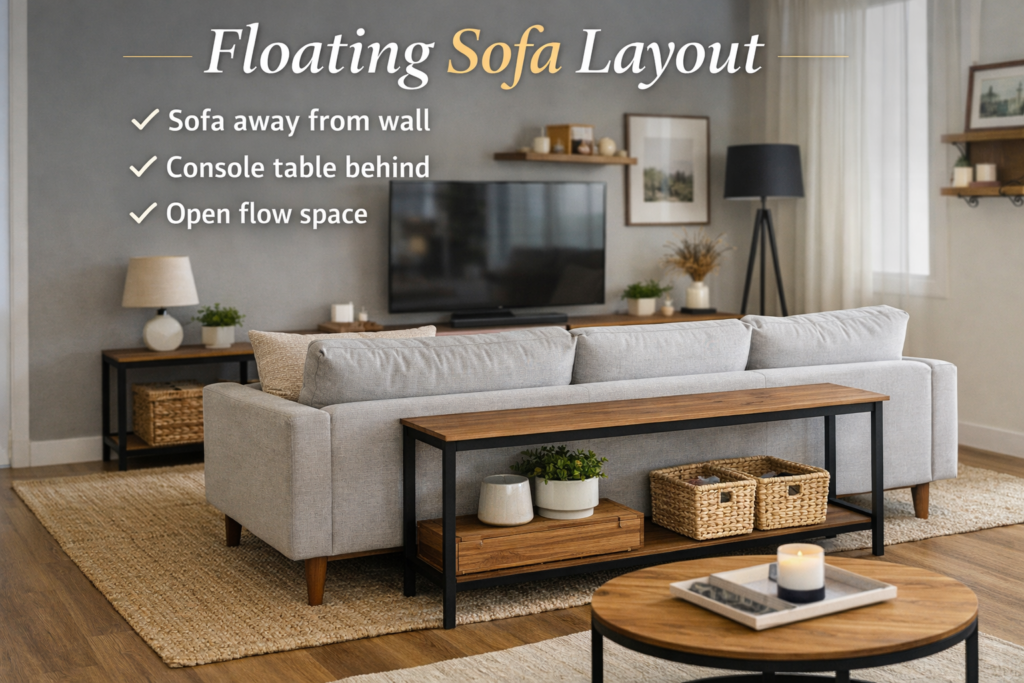
Instead of pushing your sofa tightly against the wall—which is usually a person’s first instinct—try floating it slightly forward. Surprisingly, moving it just 4 to 8 inches (10 to 20 cm) off the wall makes a massive visual difference.
How to Position It: Start by placing the sofa so it directly faces your TV or main focal point. At the same time, ensure you leave a clear walkway behind it. To finish the look, add a narrow console table (about 10–12 inches / 25–30 cm deep) right behind the sofa. As a result, this smartly creates distinct living zones without completely closing the room off.
Why It Works: Ultimately, this layout clearly defines the living area, prevents the dreaded “wall-hugging syndrome,” and drastically improves your overall traffic flow.
Pro Tip: For extra utility, use a slim console table and slide decorative storage baskets underneath it. This provides hidden organization for blankets or electronics.
What to Look For: Consider looking for slim-profile sofas (under 36 inches / 90 cm deep) and narrow console tables with open lower shelving.
2. The Corner Sectional Strategy
Best for: Perfectly square rooms and open-plan apartments.
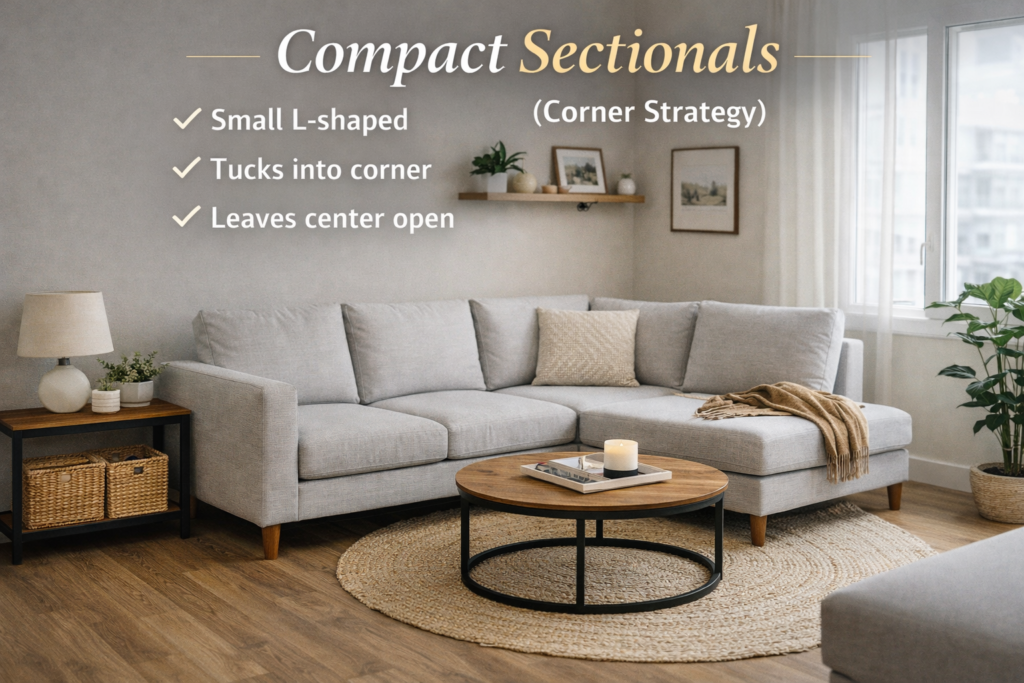
Although it might seem counterintuitive, a compact L-shaped sectional can actually save you space—provided it is sized correctly.
Ideal Measurements: Look specifically for a sectional with a total length under 90 inches (230 cm) per side, along with a depth around 34–38 inches (86–96 cm).
Placement Tips: Place the sectional tightly into one corner, which leaves the center of the room entirely open. Furthermore, always keep the chaise portion aimed toward the window so it does not block your main walkway. Afterward, pair this setup with a small round coffee table (maximum 30 inches / 76 cm in diameter). Round tables are crucial here because they naturally improve movement around the L-shape.
Pro Tip: Additionally, avoid sofas with bulky, oversized armrests. Choosing slim arms actually gives you more seating width without eating up extra floor space.
What to Look For: Keep an eye out for apartment-size sectionals and round nesting coffee tables that can be easily tucked away.
3. Wall-Mounted TV Setup
Best for: Studios and ultra-small apartment spaces.
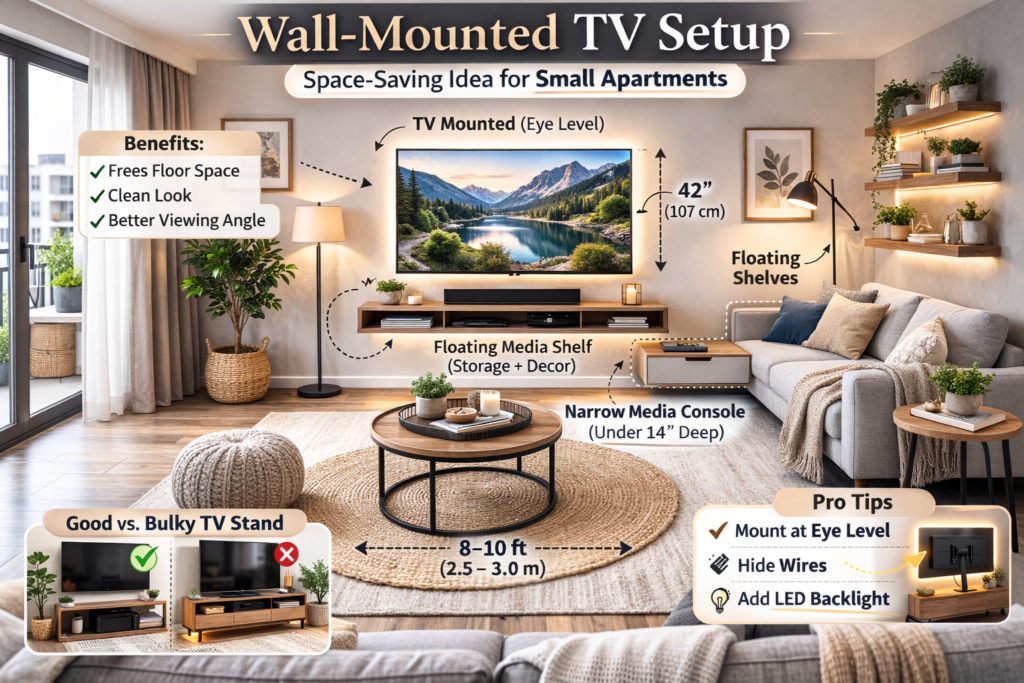
It is no secret that traditional, bulky TV stands eat up an incredible amount of precious floor space.
Layout Guidance: By mounting your TV directly on the wall, you instantly free up 4 to 6 square feet (0.4 to 0.6 square meters) of usable room. Make sure to mount the screen exactly at eye level from your seated position. Then, instead of relying on bulky cabinets, add sleek floating shelves directly below it.
Why It Works: Consequently, removing that heavy furniture from the floor makes the room feel significantly lighter and creates a much cleaner, modern aesthetic.
Pro Tip: If your lease strictly prohibits drilling heavy mounts into the walls, try using a tall, incredibly narrow open media console that is under 14 inches (35 cm) deep instead.
What to Look For: Search for heavy-duty wall-mount TV brackets alongside sleek floating media shelves.
4. Symmetrical Layout for Narrow Rooms
Best for: Long, narrow living rooms (typically around 8×14 ft / 2.4×4.2 m).
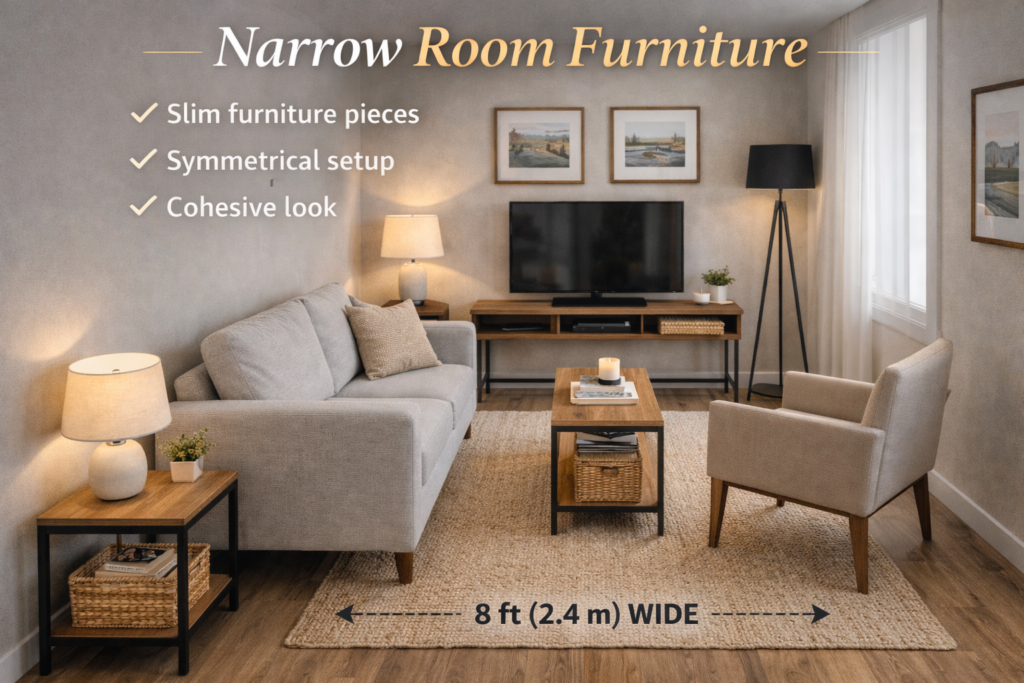
Instead of letting one massive sofa dominate the entire room, you should purposefully break the space up. Doing so counteracts the uncomfortable “bowling alley” effect.
Placement Tip: To begin, try placing a comfortable loveseat on one side of the room. Directly opposite the loveseat, arrange two slim accent chairs. Next, bridge the gap between them with a narrow, rectangular coffee table. Above all, keep all furniture pieces no deeper than 36 inches (90 cm) to ensure you maintain a usable walkway.
Why It Works: Ultimately, creating symmetry naturally draws the eye from side to side, which visually widens a tight, narrow room.
Pro Tip: When selecting your seating, choose accent chairs with exposed, raised legs. Because light can pass underneath them, they won’t weigh the room down visually.
What to Look For: Look for slim mid-century modern armchairs and narrow coffee tables featuring hidden storage compartments.
5. Multi-Functional Furniture Layout
Best for: Studio apartments under 500 sq ft (46 m²).
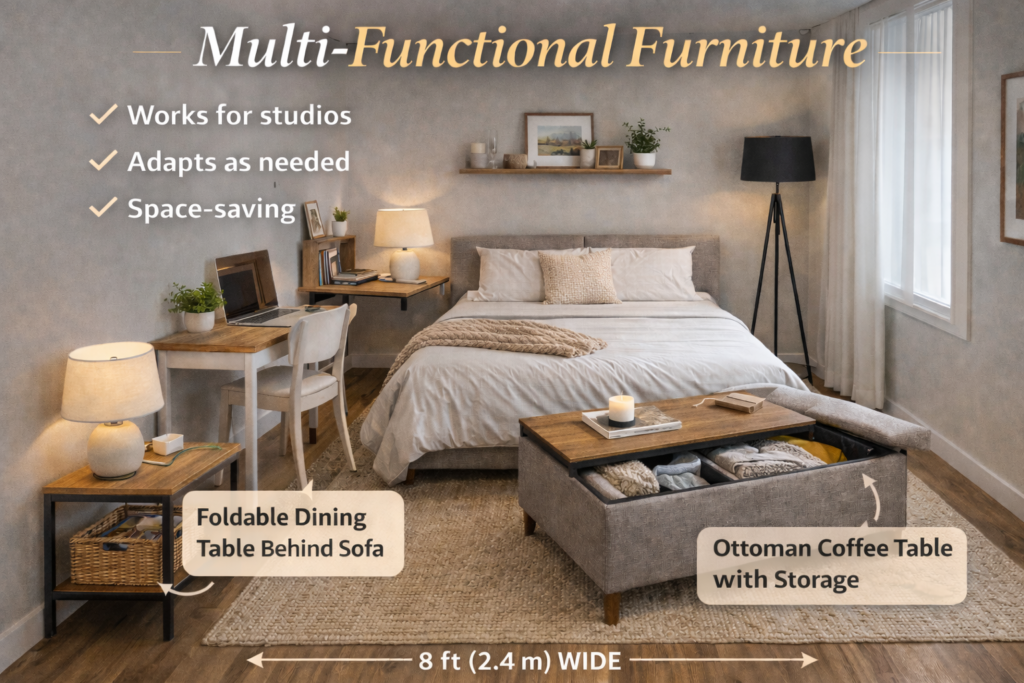
In a tiny apartment, your living room might also need to function as your home office, your dining area, and your guest bedroom. Therefore, you must deliberately choose furniture that works twice as hard.
Smart Layout Moves: For example, use a sturdy storage ottoman as your main coffee table. In addition, consider placing a foldable, drop-leaf dining table directly behind your floating sofa. Finally, utilize a sleek sofa bed along the main wall to easily accommodate overnight guests.
Pro Tip: As a general rule, always keep your multi-use, transformable pieces near the perimeter walls. This guarantees that the center of the room remains open and easy to navigate.
What to Look For: Keep an eye out for upholstered storage ottomans, highly rated convertible sofa beds, and fold-down, wall-mounted desks.
6. Vertical Storage Wall Layout
Best for: Apartments suffering from minimal closet space.
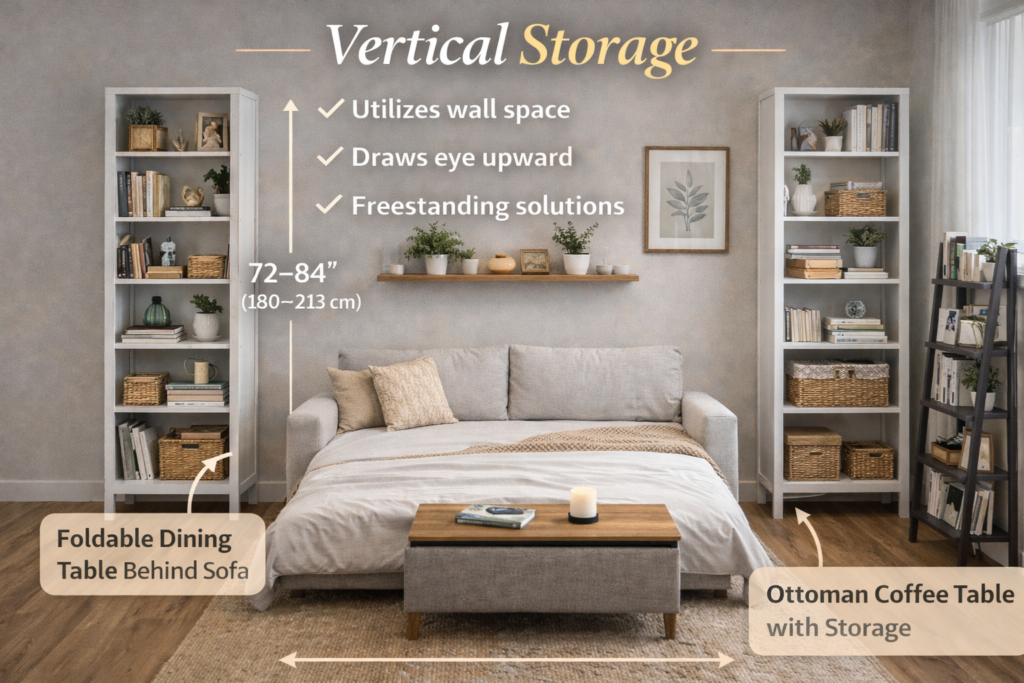
When your floor space is severely limited, the only logical direction to go is up.
Strategy: To achieve this, utilize tall bookcases that reach 72 to 84 inches (180 to 213 cm) high. You can also install wall-mounted shelving high above the sofa, or gently tuck ladder shelves neatly into tight corners.
Why It Works: This vertical strategy naturally draws the eye upward, thereby highlighting the height of the room rather than its narrow width.
Pro Tip: To maintain proper visual balance, keep your lower shelves minimal and clutter-free. Conversely, place your heavier, larger decor items on the higher shelves.
What to Look For: Narrow, extra-tall bookcases and heavy-duty wall-mounted floating shelves.
7. Window-Focused Layout
Best for: Rooms featuring large windows or beautiful natural light.
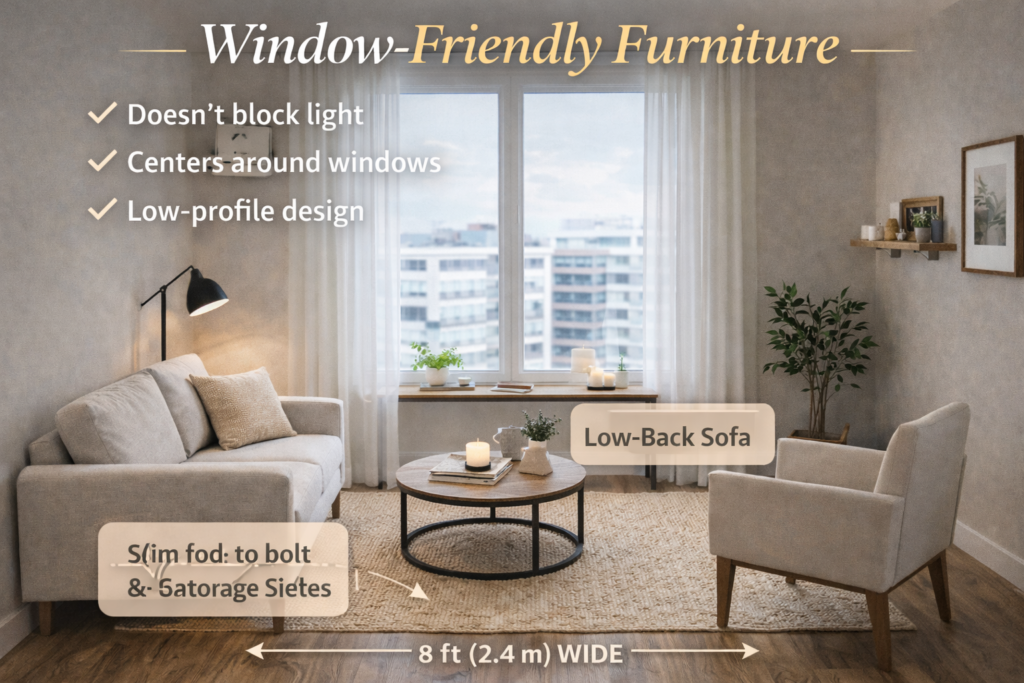
The golden rule of small space design is to never, ever block your natural light. In fact, natural sunlight is the fastest way to make a small space feel expansive.
Layout Steps: Start by placing your sofa perpendicular to the window, rather than parallel to it. If you absolutely must put furniture near the glass, only use low-profile pieces. Above all, keep the walls immediately surrounding the window as open and bare as possible.
Pro Tip: Furthermore, use light, airy sheer curtains instead of heavy, dark drapes. This ensures that light continues to filter into the room even when the curtains are drawn for privacy.
What to Look For: Low-back sofas or daybeds, alongside sheer, extra-long curtain panels.
8. Divider Layout for Studio Apartments
Best for: Open studio spaces ranging from 400 to 700 sq ft (37 to 65 m²).
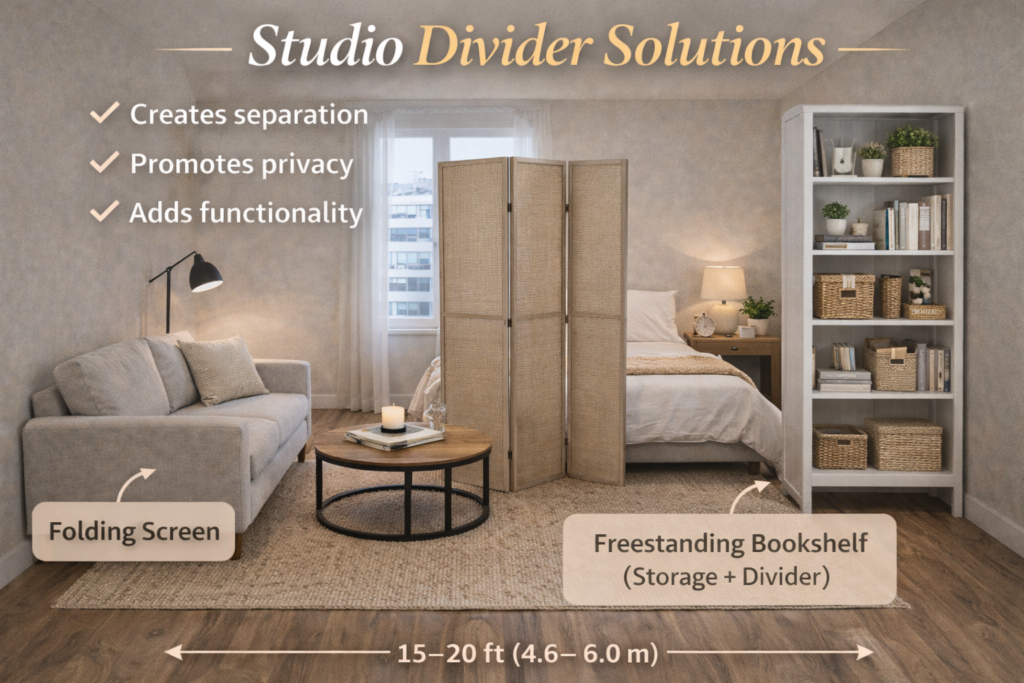
If you live in a studio, you need to cleverly create the illusion of different rooms without actually building permanent walls.
Options: For instance, use an open shelving unit as a functional room divider between your bed and the living space. Alternatively, use a slim console table positioned directly behind the sofa, or even hang a sleek curtain partition from the ceiling.
Layout Tip: Whichever option you choose, keep any physical divider under 72 inches (180 cm) tall. Doing this ensures that natural light can still flow over the top of it, maintaining an airy openness throughout the flat.
Pro Tip: Always choose open-back shelving units instead of solid wood panels. Because solid panels block sightlines, they will quickly make the space feel boxed in.
What to Look For: Search for open cube storage shelves and lightweight, folding room dividers.
9. The Minimalist Two-Piece Rule
Best for: Extremely tight, boxy rooms.
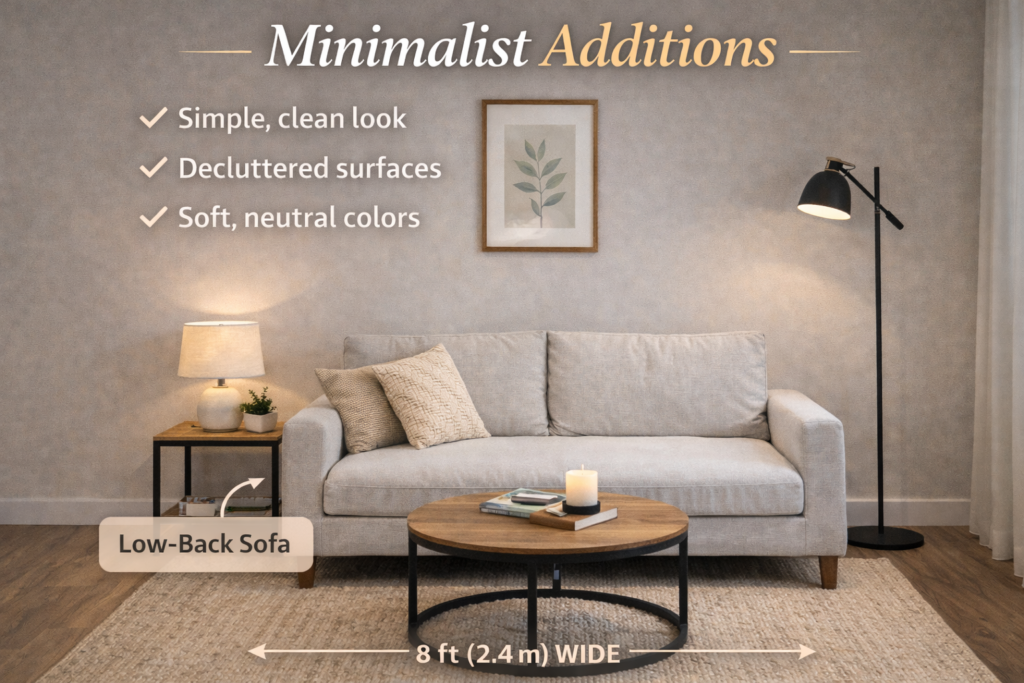
When dealing with severe space constraints, you must resist the urge to fill every corner. Instead, follow the minimalist two-piece rule: one compact sofa and one statement chair.
Why It Works: That is truly it. Add no extra side tables unless absolutely necessary. The psychology behind this is simple: more visible floor space directly translates to a larger perceived room size.
Pro Tip: Instead of using a bulky coffee table, opt for a sleek C-shaped side table that easily slides directly under the sofa frame when not in use.
What to Look For: High-quality, compact loveseats and minimalist C-shaped slide-under side tables.
Small Living Room Layout Mistakes to Avoid
Of course, even the most beautiful furniture can fail if it is placed poorly. To ensure your space works, be sure to avoid these common layout traps:
- Blocking Natural Light: Placing large bookcases or tall cabinets directly in front of windows shrinks rooms instantly by cutting off your primary light source.
- Oversized Coffee Tables: Constantly squeezing past furniture is frustrating. Therefore, always ensure you keep at least 16 to 18 inches (40 to 45 cm) of clearance between the front of your sofa and your coffee table.
- Pushing Everything Against Walls: As discussed earlier, this pushes all seating too far apart. Consequently, it creates a hollow center and awkward conversation spacing.
- Ignoring Traffic Flow: When planning your layout, walk through your room exactly as you would daily—do not just walk around it. If you bump into a chair on your way to the kitchen, the layout is fundamentally wrong.
- Too Many Small Pieces: Trying to fit multiple tiny side tables and small chairs into a room immediately creates overwhelming visual clutter. Instead, keep the piece count deliberately low.
Budget-Friendly Upgrades That Change the Layout Feel
Fortunately, you certainly do not always need to buy brand new furniture to fix your space. Here are a few budget-friendly tweaks that make a massive impact:
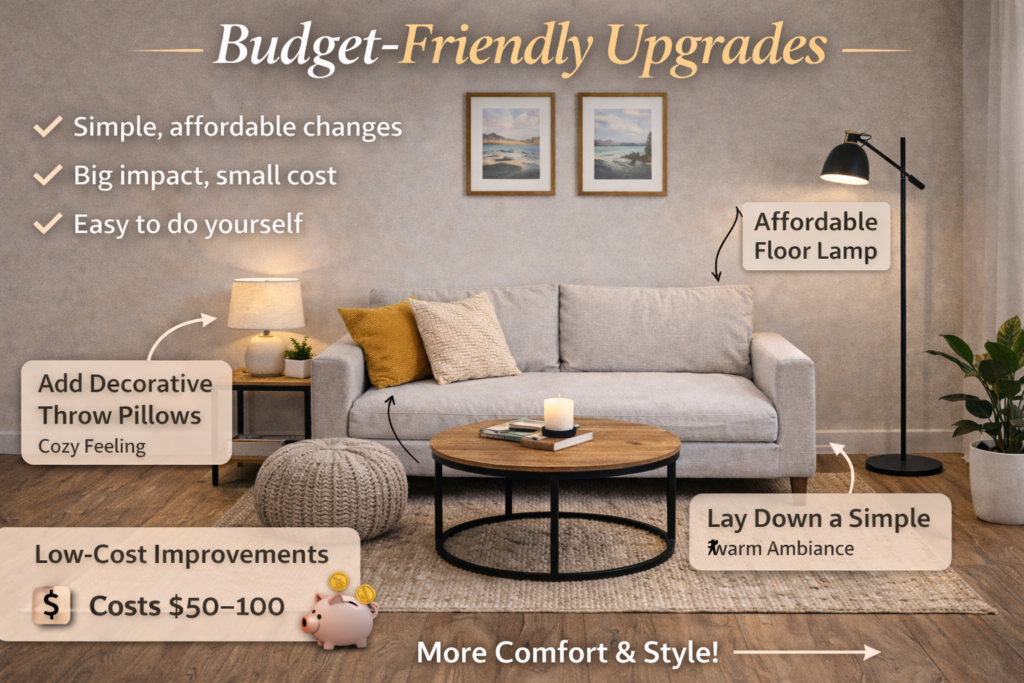
Tip Box: Use Rugs for Zoning: Using an area rug visually separates your living space from the rest of the apartment. Generally, a 5×7 ft (150×210 cm) rug is ideal for small rooms. Just ensure that at least the front legs of your sofa sit securely on the rug to tie the entire layout together.
Tip Box: Mirrors Expand Visual Space: If your room feels claustrophobic, try hanging a large mirror directly opposite your main window. This simple trick bounces light back into the room and effortlessly creates the illusion of a second window.
Tip Box: Choose Furniture with Legs:Furniture that sits flat on the floor feels incredibly heavy. By choosing sofas and chairs with exposed legs, you allow the floor to remain visible beneath the furniture, instantly creating a much-needed sense of openness.
In addition to those tips, consider these simple layout upgrades:
- Swapping out bulky floor lamps for plug-in wall sconces.
- Installing floating shelves to lift everyday items off the floor.
- Switching to light-colored, airy textiles for your throw pillows and blankets.
Buyer’s Guide: What to Look for When Buying Furniture for Small Living Rooms
Before you purchase anything new, take a tape measure and double-check your room’s dimensions. Then, keep these six crucial rules in mind:
- Sofa Depth: Standard sofas are deep and highly space-consuming. Therefore, the ideal depth for an apartment sofa is between 32 and 36 inches (81 to 90 cm).
- Leg Height: Always look for furniture that offers at least 4 to 6 inches (10 to 15 cm) of floor clearance underneath.
- Open-Base Design: Strictly avoid boxy, heavy furniture that sits completely flat on the floor.
- Foldable or Stackable Pieces: Nesting tables and folding chairs offer incredible flexibility, which is especially helpful if you like entertaining guests in a small space.
- Light & Neutral Colors: Whites, creams, and light grays naturally reflect light. Because of this, they carry far less visual weight than dark, heavy colors.
- Modular Flexibility: Look for small sectionals that can be easily reconfigured. Ultimately, pieces that separate help future-proof your furniture for when you eventually move to a new layout.
FAQ: Small Apartment Living Room Layout Ideas
1. How do I arrange a living room in a small apartment?
Focus strictly on traffic flow first. Make sure to keep at least 24 inches (60 cm) of your main walkways completely clear, avoid oversized furniture pieces, and utilize your vertical wall space for everyday storage.
2. Should I push my sofa against the wall?
Not always. In many cases, pulling the sofa slightly away from the wall (floating it) can drastically improve the room’s visual balance and help create distinct, functional zones.
3. What shape coffee table is best for small spaces?
Round or oval tables are always best. They naturally improve movement around tight corners and drastically reduce sharp edges that are easy to bump into in compact layouts.
4. How do I divide a studio apartment living room?
Use visual barriers rather than solid walls. For example, open shelving units, strategically placed area rugs, or a narrow console table positioned behind your sofa can successfully create separation without closing off the room.
5. What makes a small living room look bigger?
A strategic combination of natural sunlight, raised-leg furniture, cleverly placed mirrors, and clean, uncluttered floor space will instantly make any room feel much larger.
You May Also Like
- Vertical Victory: 4 Genius Ways to Use Your Bathroom Walls
- 4 Genius Ways to Reclaim Your Countertop
- Smart Home Upgrades for Small Apartments
(These articles perfectly complement your new small apartment layout strategy!)
Conclusion
At the end of the day, successful small apartment living isn’t about sacrificing your comfort—it is entirely about planning intentionally.
When executed correctly, the right layout naturally improves your daily movement, enhances the flow of natural light, and severely reduces visual clutter. As a result, it ultimately makes your space feel calm and welcoming. Therefore, before you rush out to buy new furniture, take a moment to rethink your current positioning. Very often, simply shifting a sofa by 6 inches (15 cm) or removing one side table can change the entire dynamic of the room.
Remember: small spaces do not require bigger budgets — they just require smarter layouts.
Disclaimer: As an Amazon Associate, I earn from qualifying purchases. This comes at no extra cost to you.