
Affiliate Disclosure: As an Amazon Associate, Smart Deal Finds earns from qualifying purchases. This means if you click on a link and buy something, we may receive a small commission at no extra cost to you. This supports our blog and allows us to keep testing the latest smart home gadgets for you!
Key Takeaways: The Smart Deal Finds Verdict
| Feature | Old Cloud Cameras (Legacy) | New Edge-AI Cameras (2026) |
| Architecture | Server-side processing (Cloud) | Edge Computing (On-Device NPU) |
| Latency | 3-5 seconds (Round-trip delay) | <0.5 seconds (Real-time local logic) |
| Privacy Model | Data leaves the premises | Data stays local (GDPR Compliant) |
| Cost Structure | OPEX (Monthly fees €100+/yr) | CAPEX (Higher upfront, €0 monthly) |
| Our Top Pick | Obsolete | Eufy S330 (Best Engineering) / Ring floodlight (Best Connectivity) |
The AI Home Security Revolution: Why Your Old Camera is Costing You Money
Hello, Smart Deal Finds readers! 🏠
If you bought a security camera five years ago, you likely know the drill: your phone buzzes at 2:00 AM, waking you up in a panic, only for you to discover it was a spider crawling across the lens or a tree branch swaying in the wind. This is known in the industry as a “false positive,” and it plagues older systems that rely on simple pixel-based motion detection.
This is the “Dumb Camera” era—and here at Smart Deal Finds, we believe it’s over.
We’ve been testing the latest tech across both the USA and Germany, and a quiet revolution has taken place. The latest generation of security cameras—led by the Arlo Pro 6 and EufyCam S330—has moved beyond simple motion triggers. They now utilize Edge AI technology. Unlike cloud cameras that upload video to a remote server for analysis (incurring latency and subscription fees), these new devices contain a dedicated Neural Processing Unit (NPU) inside the camera itself.
From an engineering perspective, this shift is massive:
- Latency Reduction: By processing data on the “Edge” (the camera), alerts are generated in milliseconds rather than seconds.
- Bandwidth Conservation: The camera only uploads video when it confirms a threat, saving your home network’s upload bandwidth.
- Privacy (GDPR Friendly): For our readers in Germany, this is critical. New AI features allow for “Privacy Masking” where specific pixels are digitally blacked out before the file is ever written to storage, ensuring compliance with strict Persönlichkeitsrecht (personality rights) laws.
Related Reading: Just starting your smart home journey? Check out our guide on [Smart Bedroom Gadgets That Actually Improve Sleep, Mood & Comfort (Smart Homes – 2026)].
1. The Privacy King: EufyCam S330 (EufyCam 3)
Best For: German homeowners, Privacy advocates, and Engineering enthusiasts who value specs.
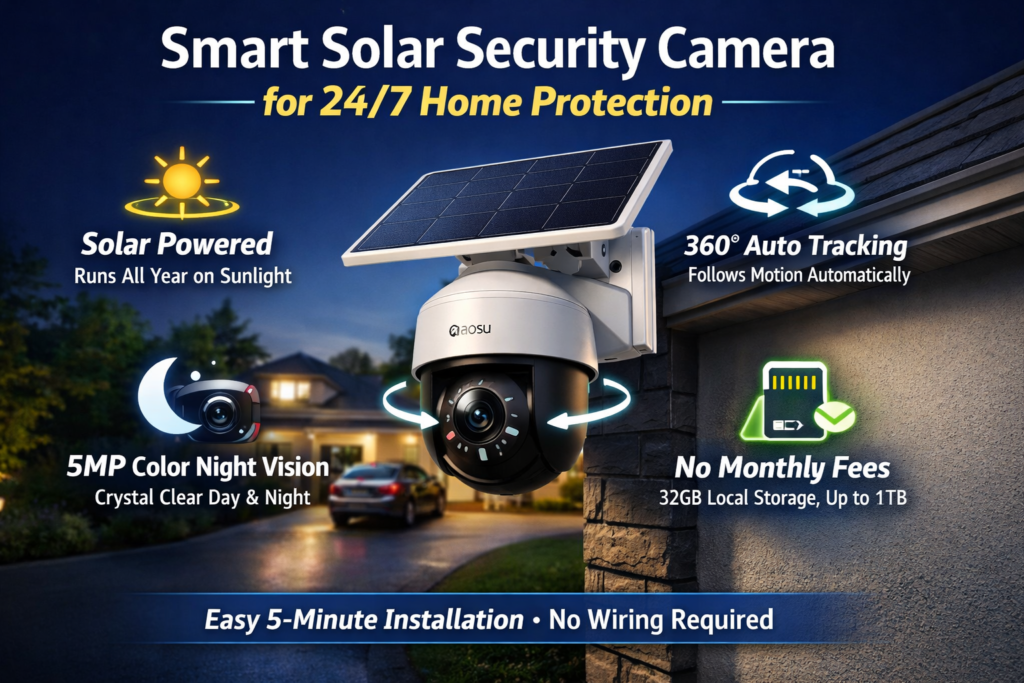
The EufyCam S330 represents a paradigm shift in how we think about home security power management. It introduces BionicMind™, a self-learning AI algorithm that runs locally on the HomeBase 3 hub.
⚙️ Engineering Deep Dive
The most impressive aspect of the S330 is its optical and power efficiency. Eufy has integrated a high-efficiency monocrystalline solar panel directly into the top surface of the camera. Unlike older solar techs that required direct, blazing sun, these panels use SunPower cells that can harvest energy even in overcast conditions—crucial for German winters.
Furthermore, the lens utilizes an f/1.4 aperture. For the non-photographers, a lower f-stop number means the lens opening is wider. An f/1.4 lens lets in roughly 40% more light than the standard f/2.0 lenses found in cheaper competitors. This allows the sensor to capture color images in low light without relying heavily on the noisy digital gain (ISO), resulting in cleaner, sharper night footage.
Technical Specifications Table
| Feature | Specification | Engineering Benefit |
| Resolution | 4K Ultra HD (3840 x 2160) | Allows 4x digital zoom without pixelation (reading plates). |
| Aperture | f/1.4 | Superior low-light performance; less reliance on IR LEDs. |
| AI Processor | BionicMind™ (NPU) | 99.9% recognition accuracy; learns faces over time. |
| Storage | 16GB (Internal) + 16TB (Expandable) | Supports 2.5″ SATA HDD/SSD; true local ownership. |
| Encryption | AES-128 + RSA-1024 | Bank-grade encryption ensures data is unreadable if stolen. |
| IP Rating | IP67 | Dust tight & immersion up to 1m (Better than IP65). |
Why We Recommend It
We recommend the Eufy S330 primarily for its Total Cost of Ownership (TCO). While the upfront price is higher (€400+ for a kit), the operational expenditure is zero. There are no monthly fees. Additionally, the HomeBase 3 acts as a local server. If your internet goes down, the cameras still record to the HomeBase. This redundancy is vital for serious security.
2. The Connectivity Master: Arlo Pro 6
Best For: Users with mesh Wi-Fi systems and Smart Home ecosystems (Google/Alexa).
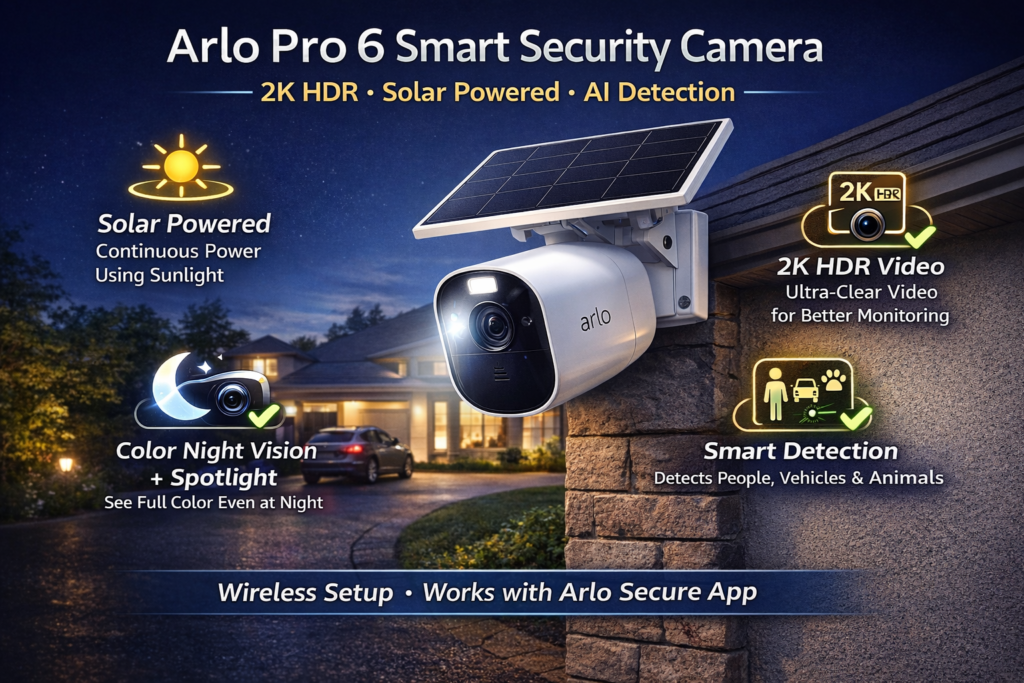
The Arlo Pro 6 (6th Gen) is the connectivity champion. While many cameras still struggle on the crowded 2.4GHz Wi-Fi band (which is shared by your microwave, Bluetooth, and baby monitors), the Arlo Pro 6 utilizes Dual-Band Wi-Fi (2.4GHz & 5GHz).
⚙️ Engineering Deep Dive
The inclusion of 5GHz support is a game-changer for urban environments (like apartments in Berlin or New York) where the 2.4GHz spectrum is saturated with interference. 5GHz offers higher data throughput (up to 1300 Mbps theoretical), which is essential for streaming the Arlo’s high-bitrate 2K HDR video without buffering.
Moreover, the Image Signal Processor (ISP) in the Arlo Pro 6 is tuned for High Dynamic Range (HDR). In a security context, HDR is not just about pretty colors; it’s about information retrieval. If a thief is standing in a shadowed porch while the sun is blasting the background, a standard camera will either expose for the sun (making the thief a silhouette) or the porch (blowing out the background). The Arlo Pro 6 captures multiple exposures simultaneously and merges them, ensuring you see the face and the car in the background clearly.
Technical Specifications Table
| Feature | Specification | Engineering Benefit |
| Resolution | 2K HDR (2560×1440) | Optimized balance between detail and bandwidth usage. |
| Field of View | 160° Diagonal | Ultra-wide angle reduces blind spots; fewer cameras needed. |
| Wi-Fi | Dual-Band (2.4/5GHz) | Auto-switching ensures connection stability in noisy RF environments. |
| Pre-Roll | 4-Second Lookback | Buffers video constantly to capture events before triggers. |
| Audio | Full Duplex + Noise Cancellation | Allows simultaneous 2-way talk without “walkie-talkie” cutting out. |
Why We Recommend It
We recommend the Arlo Pro 6 for its user experience (UX). The app is polished, fast, and the “Rich Notifications” (which send a snapshot to your Apple Watch or Lock Screen) are the fastest in the industry. If you want a system that “just works” and integrates seamlessly with your existing smart home, this is the choice.
3. The Deterrent: Ring Floodlight Cam Wired Pro
Best For: Driveways, backyards, and high-threat areas requiring active deterrence.
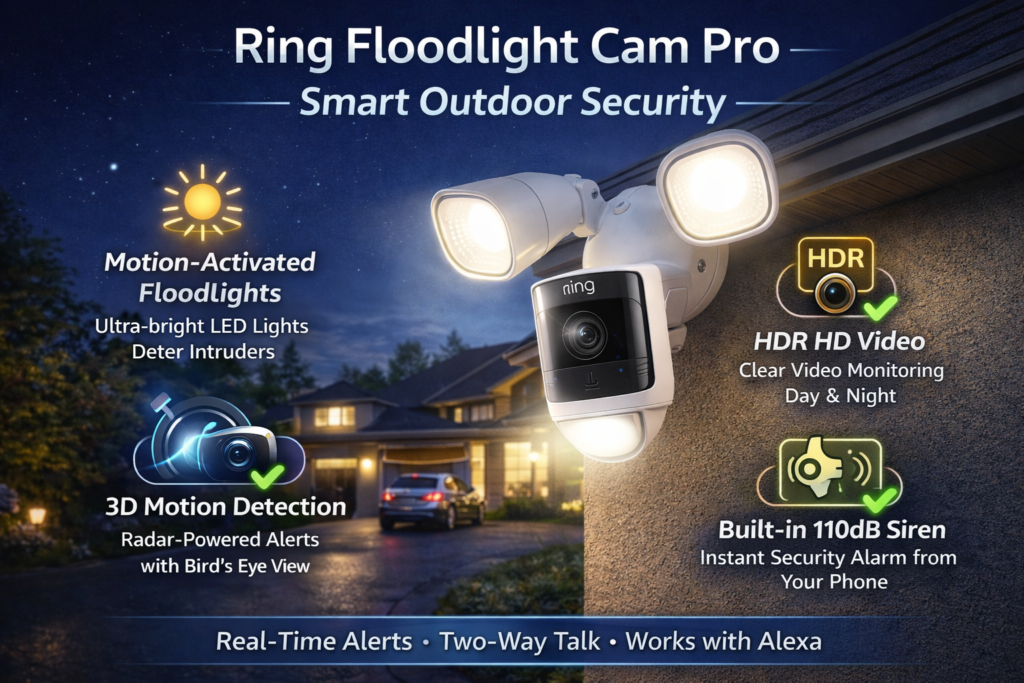
The Ring Floodlight Cam Wired Pro differentiates itself by using Radar technology alongside optical sensors. This feature, marketed as 3D Motion Detection, solves one of the oldest problems in outdoor security: distance perception.
⚙️ Engineering Deep Dive
Standard Passive Infrared (PIR) sensors detect heat signatures moving across a plane. They struggle to tell the difference between a person 5 meters away and a large truck 20 meters away.
Ring solves this by embedding a 24GHz Millimeter-Wave (mmWave) Radar sensor. This radar bounces radio waves off objects to calculate their precise distance and trajectory (velocity). This allows you to set a literal “tripwire” at a specific distance (e.g., “Only alert me if an object crosses the 10-meter mark”). This drastically reduces false alarms from sidewalk traffic.
Furthermore, the “Bird’s Eye View” feature uses this radar data to generate a top-down satellite map overlay, showing the path the intruder took across your property. From a forensic standpoint, this is invaluable for law enforcement.
Technical Specifications Table
| Feature | Specification | Engineering Benefit |
| Sensor Type | Optical + 24GHz Radar | Radar adds depth perception for fewer false alarms. |
| Lighting | 2,000 Lumens (3000K) | High-intensity LED floods capable of illuminating 100ft. |
| Siren | 110dB | Acoustic pressure equivalent to a car horn/concert. |
| Power Input | 110V – 240V AC | Hardwired connection means zero battery maintenance. |
| Connectivity | Wi-Fi 802.11 ac | Supports high-speed data transfer for HD streaming. |
Why We Recommend It
We recommend the Ring Floodlight Pro as a primary deterrent. Cameras like Eufy and Arlo are great for recording crime; the Ring Floodlight is designed to prevent it. The moment the radar detects a person, the 2,000-lumen lights blast on. Psychologically, this “spotlight effect” forces intruders to flee immediately.
Installation Guide: Engineering Your Setup
Proper installation is just as important as the hardware itself. At Smart Deal Finds, we see too many great cameras installed poorly. Here is how to install like a pro:
1. Optimal Mounting Height
The Sweet Spot: Mount your cameras 2.5 to 3 meters (8-10 feet) off the ground.
- Too Low: An intruder can easily smash it with a baseball bat.
- Too High: You only capture the top of their head (hoodie/cap), making facial recognition impossible.
2. The “Cross-Zone” Technique
PIR sensors are most sensitive to movement across the frame, not towards the camera.
- Don’t: Point the camera directly down the walkway where the subject walks straight at the lens.
- Do: Position the camera at a 45-degree angle to the walkway. This ensures the subject moves across the sensor’s field of view, triggering the recording instantly.
3. Material Considerations (Germany vs. USA)
- USA (Wood/Siding): Standard screws work fine. Ensure you silicone caulk the top and sides of the mount to prevent water ingress behind the siding.
- Germany (Concrete/Insulation – WDVS): Most German homes use thick external insulation (Wärmedämmverbundsystem). Do not just screw into the styrofoam; the camera will sag or fall. You must use specialized insulation anchors (Dämmstoffdübel) like the Fischer FID 50, or drill deep into the masonry behind the insulation using a hammer drill and long screws (100mm+).
Network Engineering: Ensuring 24/7 Uptime
A wireless camera is only as good as its Wi-Fi signal. Here is the technical reality of signal penetration:
- 2.4GHz: Better at penetrating solid objects (brick, concrete, water pipes). It has a longer wavelength. Use this band for cameras on the exterior of a brick home (common in Europe).
- 5GHz: Faster speeds but poor penetration. Use this for cameras close to the router or with line-of-sight (e.g., indoor cameras or outdoor cameras near a window).
If you have a large property (>150 sqm), a single router will not suffice. We strongly recommend upgrading to a Mesh Wi-Fi 6 System (like Eero or Orbi). Place a satellite node near the wall closest to your outdoor cameras to bridge the signal gap.
Legal & Privacy: Navigating GDPR (Germany Focus)
For our readers in Germany, the Datenschutz-Grundverordnung (DSGVO/GDPR) is strict. Failure to comply can result in fines. Here is your checklist:
- Public Space Prohibition: You strictly cannot record the public sidewalk (Gehweg) or street. The camera’s view must end at your property line (Grundstücksgrenze).
- Privacy Masking: Use the Eufy or Arlo app to draw black boxes over your neighbor’s property or shared driveways.
- Hinweisschild (Signage): You must post a visible sign stating “Videoüberwachung” (Video Surveillance) at the entrance to your property, informing visitors they are being recorded before they enter the camera’s field of view.
- Data Retention: Generally, footage should be deleted after 72 hours unless it documents a specific crime. The Eufy HomeBase’s “Overwrite” feature handles this automatically.
Frequently Asked Questions (FAQ)
Q: What is the difference between optical zoom and digital zoom?
A: Optical zoom moves the physical glass lens to magnify the image, retaining 100% quality. Digital zoom (used by Eufy, Arlo, Ring) simply crops the image and enlarges the pixels. This is why 4K resolution (Eufy S330) is superior; it provides more “pixels per inch,” allowing you to digital zoom up to 8x and still read a license plate.
Q: Can I use these cameras in freezing temperatures?
A: Yes. Lithium-ion batteries struggle in extreme cold (below -5°C / 23°F) because the chemical reaction slows down.
- Arlo & Eufy: Use software to prevent charging when frozen (to avoid battery damage). The camera will run but won’t charge.
- Solution: For regions like Bavaria or Minnesota, we recommend the Wired Ring Floodlight or permanently plugging the Arlo into AC power, as the internal heat from the electronics keeps the unit operational down to -20°C.
Q: Is local storage really safer than the cloud?
A: From a cybersecurity standpoint, yes. Cloud servers are centralized “honeypots” for hackers. If a cloud provider is breached, millions of videos are at risk. With local storage (Edge AI), your footage exists only on the encrypted drive in your living room. An attacker would physically need to break into your house to steal the data.
Read Next on Smart Deal Finds
If you enjoyed this technical deep dive into home security, make sure to read these related guides to complete your smart home setup:
- High Electric Bill? 5 Smart Gadgets With 3-Month ROI – Save money to pay for your new cameras.
- 4 Smart Home Gifts for Him He’ll Actually Use Every Day – More tech inspiration.
- The Best Home Office Chair for Back Pain in 2026 – Comfort for your home office monitoring station.
Next Step: Are you ready to upgrade your home security?
- For the Engineer/Privacy Advocate: The Eufy S330 Kit is the superior choice for its local NPU and f/1.4 optics.
- For the Smart Home Integrator: The Arlo Pro 6 offers the best connectivity and app experience.